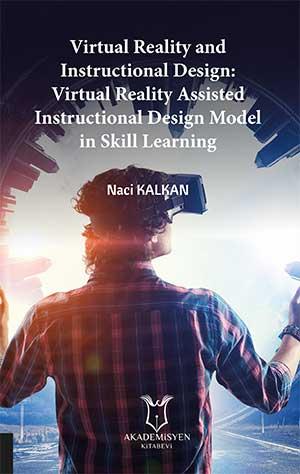
Virtual Reality and Instructional Design: Virtual Reality Assisted Instructional Design Model in Skill Learning
Özet
This book investigates how Virtual Reality (VR) technology can be used in educational design. The authors present a Virtual Reality Supported Education Design Model to demonstrate how VR can be effectively utilized in skill learning processes. The book is written by Dr. Naci Kalkan and Dr. Hüseyin Çamliyer and is derived from the doctoral thesis titled \"Investigating the Effectiveness of Virtual Reality Technology in Learning Basic Technical Skills: The Case of Table Tennis\" approved by the Faculty of Sports Sciences at Manisa Celal Bayar University. It can be a valuable resource for researchers, educators, and designers who are interested in exploring the potential of VR in education.
Referanslar
Açıkgöz, K. Ü. (2003). Aktif öğrenme. Eğitim Dünyası Yayınları.
Akdemir, A. (2009). Laparoskopik cerrahi eğitiminde sanal gerçeklik teknolojisi, Yayınlanmamış uzmanlık tezi, Ege Üniversitesi, İzmir.
Akpınar, Y. (1999). Bilgisayar Destekli Öğretim ve Uygulamalar. (1). Ankara: Anı Yayıncılık.
Ali Şimşek (2009) Öğretim Tasarımı, Nobel Yayın Dağıtım, Ankara
Alpar D., Batdal G., Avcı Y., Hasan Ali Yücel Eğitim Fakültesi Dergisi Sayı 7 (2007-1), 19-31
Amon, T., & Valencic, V. (2000). Biological worlds on the Internet in virtual reality an educational aid. PFLUGERS ARCHIV, 439(3; SUPP/1), R225-R225.
Anderson, F., & Bischof, W. F. (2013, April). Learning and performance with gesture guides. In Proceedings of the SIGCHI Conference on Human Factors in Computing Systems (pp. 1109-1118).
Arıcı, V. A. (2013). Fen Bilimleri Eğitiminde Sanal Gerçeklik Uygulamaları Üzerine Bir Çalışma: "Güneş Sistemi ve Ötesi: Uzay Bilmecesi" Ünitesi Örneği. Aydın: Adnan Menderes Üniversitesi Fen Bilimleri Enstitüsü.
Balkó, Š., Heidler, J., & Edl, T. (2018). Virtual reality within the areas of sport and health. Trends in Sport Sciences. https://doi.org/10.23829/TSS.2018.25.4-1
Barlow, John Perry (1990). "Being in Nothingness". Wired Magazine.
Battig WF. Facilitation and interference. In: Bilodeau E, editor. Acquisition of Skill. New York, NY, USA: Academic Press; 1966. s. 215–44.
Battig WF. The flexibility of human memory. In: Cermak LS, Craik FIM, editors. Levels of Processing and Human Memory. Hillsdale, NJ: Lawrence Erlbaum Associates; 1979. s. 23–44.
Bayraktar, E. Kaleli F. (2007, 31 Ocak - 2 Subat ). Sanal Gerçeklik ve Uygulama Alanları. Dumlupınar Üniversitesi Akademik Bilisim 2007, Kütahya.
Brady F. Contextual interference: a meta-analytic study. Percept Motor Skills 2004;99(1):116–26.
Braund, P.,Frauscher, K., Schwittay, A., ve Petkoski, D., (2006), Information and Communications Technology for Economic Development, Exploring Possibilities for Multi-sector Technology Collaborations A Report on the Global E-Discussion, World Bank Institute’s Business, Competitiveness, and Development Team and the RIOS Institute.
Brooks, F. P. (1999). What's real about virtual reality?. IEEE Computer graphics and applications, 19(6), 16-27.
Bruyn, L. L. (2004). Monitoring online communication: can the development of convergence and social presence indicate an interactive learning environment?. Distance Education, 25(1), 67-81
Bryson, S. (2004). Virtual reality. In Computer Science Handbook, Second Edition. https://doi.org/10.7748/ns2013.09.28.4.29.s32
Bulu, S. T., & İşler, V. (2011). Second life odtü kampüsü. Akademik Bilişim Kongresi’nde sunulan bildiri. İnönü Üniversitesi, Malatya. Kasım, 15, 2011.
Bulun, M. ve Kapıcıoğlu, M.D. (2003). Tıp eğitiminde bilisim teknolojileri kullanımı, http://ab.org.tr/ab03/tammetin/81.doc 14.03.2018.
Burdea, G. C. (2003). Virtual Rehabilitation - Benefits and Challenges. Methods of Information in Medicine. https://doi.org/10.1055/s-0038-16381563
Burdea, G. C., & Coiffet, P. (2003). Virtual reality technology (2nd ed.). John Wiley & Sons.
Burdea, G., & Coiffet, P. (1994). Virtual Reality Technology. John Wiley& Sons. Inc-1993.
C. Cruz-Neira: Virtual Reality Overview. SIGGRAPH’93 Course, No. 23, s. 1.1-1.18 (1993)
Chang, G., Morreale, P., & Medicherla, P. (2010, March). Applications of augmented reality systems in education. In Society for Information Technology & Teacher Education International Conference (pp. 1380-1385). Association for the Advancement of Computing in Education (AACE).
Chen, C. J. (2006). The design, development and evaluation of a virtual reality based learning environment. Australasian Journal of Educational Technology. https://doi.org/10.14742/ajet.1306
Choi, S., Jung, K., & Noh, S. D. (2015). Virtual reality applications in manufacturing industries: Past research, present findings, and future directions. Concurrent Engineering, 23(1), 40-63.
Coates, G. (1992). Program from Invisible Site—a virtual sho, a multimedia performance work presented by George Coates Performance Works, San Francisco, CA, March, 1992.
Cohen, C. J., Hay, R., Urquhart, A., Gauger, P., & Andreatta, P. (2005). A Modular Interactive Virtual Surgical Training Environment. Interservice/Industry Training, Simulation, and Education Conference (I/ITSEC).
Collins, A. (1988). Cognitive apprenticeship and instructional technology (Technical Report No. 6899). Cambridge, MA: BBN Labs Inc.,
Craig, A. & Sherman B. (2003) Understanding Virtual Reality, Interface, Application and Design s. 32 Morgan Kaufmann Publishers
Çavaş, B., Huyugüzel Çavaş, P. ve Taşkın Can, B. (2004). Eğitimde sanal gerçeklik. The Turkish Online Journal of Educational Technology, 3 (4), 110-116.
Çavaş, B., Huyugüzel, P., Can, B. 2004, Eğitimde sanal gerçeklik. The Turkish Online Journal of Educational Technology [Electronic Journal], 3: 110-116, Erişim [http://www.tojet.net/articles/v3i4/3415.pdf].
Çoruh, L., (2011) Sanat Tarihi Dersinde Bir Öğrenme Modeli Olarak Sanal Gerçeklik Uygulamasının Etkililiğinin Değerlendirilmesi (Erciyes Üniversitesi Mimarlık ve Güzel Sanatlar Fakülteleri Örneği Uygulaması. Gazi Üniversitesi Eğitim Bölümleri Enstitüsü. Doktora tezi.
Dalgarno, B. (2002). The potential of 3D virtual learning environments: A constructivist analysis. Electronic Journal of Instructional Science and Technology, 5(2), 3-6
Dalgarno, B., & Lee, M. J. W. (2010). What are the learning affordances of 3-D virtual environments? British Journal of Educational Technology, 41(1), 10–32
Dalgarno, B., & Lee, M. J. W. (2010). What are the learning affordances of 3-D virtual environments? British Journal of Educational Technology. https://doi.org/10.1111/j.1467-8535.2009.01038.x
Dede, C. 2006. Introduction to virtual reality in education. Themes in Science and Technology Education, 1: 7-9.
Diamond, R. M. (1989). Designing & improving courses and curricula in higher education: A systematic approach. San Francisco, CA: Jossey-Bass.
Dick, W. Carey, L. Carey, J. (2001), “The Systematic Design of Instruction,” New York: Long Man
Dikmenli, M., Bozkurt, E., Altunsoy, S. 2007. Fen öğretiminde sanal gerçeklik uygulamaları. http://bots.comu.edu.tr/turkce/poster.pdf#page=42],
Du, X., ve Arya, A. (2015). Design and Evaluation of a learning assistant system with optical head-mounted display (OHMD). In Learning and Collaboration Technologies (pp. 75-86). Springer, Cham.
Dunleavy, M., Dede, C., & Mitchell, R. (2009). Affordances and Limitations of Immersive Participatory. J Sci Educ Techno(18), 7–22
Engler, Craig E. (1992)."Affordable VR by 1994". Computer Gaming World. s. 80
Esgin, E., Pamukçu, S.B., Ergül, P. ve Ansay, S. (2011). 3-Boyutlu Çevrimiçi Sosyal Ortamların Eğitimde Kullanılmasının Öğrenci Başarısı ve Motivasyonuna Etkisi: Secondlife Uygulaması. 5th International Computer & Instructional Technologies Symposium, 22-24 September 2011 Fırat University, ELAZIĞ- TURKEY. 476-484.
Farrow, M., Lutteroth, C., Rouse, P. C., & Bilzon, J. L. J. (2018). Virtual-reality exergaming improves performance during high-intensity interval training. European Journal of Sport Science. https://doi.org/10.1080/17461391.2018.1542459
Ferry, B., Kervin, L., Cambourne, B., Turbill, J., Puglisi, S., Jonassen, D., & Hedberg, J. (2004). Online classroom simulation: The next wave for pre-service teacher education. In Beyond the comfort zone: Proceedings of the 21st ASCILITE Conference (pp. 294-302). Perth: Australian Society for Computers in Learning in Tertiary Education.
Gagne, R. M. (1988). Mastery Learning and Instructional Design. Performance Improvement Quarterly. https://doi.org/10.1111/j.1937-8327.1988.tb00003.x
Gagne, R.M. (1977) The conditions of learning. 3rd Edition, Holt, Rinehart, and Winston, New York.
Ganier, F., Hoareau, C., & Devillers, F. (2013). Learning a procedural task in a virtual environment for training: Evaluation of performance and workload. Travail Humain. https://doi.org/10.3917/th.764.0335
Gerlach, L., & Ely, D. (1980).Teaching and media: A systematic approach (2nd ed.). Englewood Cliffs, NJ: Prentice-Hall.
Gonzales, D., Criswell, D., & Heer, E. (1991). Automation and Robotics for the Space Exploration Initiative: Results from Project Outreach (No. RAND/N-3284-AF/NASA). RAND CORP SANTA MONICA CA.
Goodman D, Wilberg RB, Franks IM, editors. Differing Perspectives in Motor Learning, Memory, and Control; Vol. 27, Advances in Psychology. North-Holland; 1985. s. 3–22.
Goodwin, M. S., Wiltshire, T., & Fiore, S. M. (2015). Applying research in the cognitive sciences to the design and delivery of instruction in virtual reality learning environments. Lecture Notes in Computer Science (Including Subseries Lecture Notes in Artificial Intelligence and Lecture Notes in Bioinformatics). https://doi.org/10.1007/978-3-319-21067-4_29
Göksu, F., (2017) Çocuklarda Venöz Kan Alımı Sırasında Kullanılan Sanal Gerçeklik Gözlüğünün Hissedilen Ağrı Üzerine Etkisi. Bülent Ecevit Üniversitesi Sağlık Bilimleri Enstitüsü.85s.
Greenbaum, P. (1992, March). The lawnmower man. Film and video, 9 (3), s. 58-62.
Gutierrez, M.A., Vexo, F. ve Thalmann, D. (2008). Stepping into Virtual Reality, Springer 2008, ISBN: 978-1-84800-116-9.
Güzeller, C , Korkmaz, Ö . (2007). Bilgisayar Destekli Öğretimde Bir Ders Yazılımı Değerlendirmesi. Kastamonu Eğitim Dergisi , 15 (1) , 155-168 .
H. Fuchs, G. Bishop et al.: Research Directions in Virtual Environments. NFS Invitational Workshop, Univ. North Carolina (1992)
Hacer Karacan. The Role Of Familiarity On Change Perception. The Middle East Technical University, Ankara, 2007.
Hand, B., & Treagust, D. F. (1991). Student Achievement and Science Curriculum Development Using a Constructive Framework. School Science and Mathematics. https://doi.org/10.1111/j.1949-8594.1991.tb12073.x
Hanehalkı Bilişim Teknolojileri Kullanım Araştırması TÜİK 2013 erişim linki http://www.tuik.gov.tr/PreHaberBultenleri.do?id=15866
Hannafin, M. J., & Peck, K. L. (1988). The design, development, and evaluation of instructional software. Computers & Education. https://doi.org/10.1016/0360-1315(90)90011-U
Hanson, K., & Shelton, B. E. (2008). Design and development of virtual reality: Analysis of challenges faced by educators. Educational Technology and Society.
Hasselbring, T., Sherwood, R., Bransford, J., Fleenor, K., Griffith, D., & Goin, L. (1987). An Evaluation of a Level-One Instructional Videodisc Program. Journal of Educational Technology Systems. https://doi.org/10.2190/br31-j510-cxm4-k41e
Henderson, A., Korner-Bitensky, N., & Levin, M. (2007). Virtual reality in stroke rehabilitation: A systematic review of its effectiveness for upper limb motor recovery. Topics in Stroke Rehabilitation. https://doi.org/10.1310/tsr1402-52
Herrington, J., & Oliver, R. (2000). An instructional design framework for authentic learning environments. Educational Technology, Research and Development, 48(3), 23–48.
Holly Brockwell (2016) ‘’Forgotten genius: the man who made a working VR machine in 1957". Tech Radar.
Horowitz, Ken (December 28, 2004). "Sega VR: Great Idea or Wishful Thinking?". Sega-16.
İşman, A. (2008). Uzaktan eğitim. Pegem Akademi.
Jonassen, D. H. (1999). Computers as mindtools for schools: Engaging critical thinking. NJ: Prentice Hall, Inc. Smeets, E. (2005). Does ICT contribute to powerful learning environments in primary education? Computers & Education, 44(3), 343–355
Joo, Y. J., Bong, M., & Choi, H. J. (2000). Self-efficacy for self-regulated learning, academic self-efficacy, and internet self-efficacy in web-based instruction. Educational Technology Research and Development. https://doi.org/10.1007/BF02313398
Kayabaşı, Y. (2005, July). Sanal Gerçeklik ve Eğitim Amaçlı Kullanılması. The Turkish Online Journal of Educational Technology – TOJET
Kemp, J. E. (1986). Training for instructional design. Learning I. D. through the I. D. process. Performance + Instruction. https://doi.org/10.1002/pfi.4150250205
Kenneth J. Varnum. Chicago, IL: ALA Editions"Beyond Reality: Augmented, Virtual, and Mixed Reality in the Library." Journal of Electronic Resources Librarianship, 31(4), s. 283–284.
Keskin, İ. (2017). Matematik öğretmeni adaylarının eğitimde sanal gerçeklik kullanımına ilişkin görüşlerinin değerlendirilmesi. Avrasya Sosyal ve Ekonomi Araştırmaları Dergisi (ASEAD), 4(11).
Kim, D., & Ko, Y. J. (2019). The impact of virtual reality (VR) technology on sport spectators' flow experience and satisfaction.
Kimble, G. A. (1961). Hilgard and Marquis'" Conditioning and learning.".
Knirk, F., & Gustafson, K. (1986).Instructional technology: A systematic approach to education. New York: Holt, Rinehart, & Winston.
Knowles, M. S. (1975). Self-directed learning: a guide for learners and teachers. Selfdirected Learning A Guide for Learners and Teachers.
Kreylos, O., (2016) Lighthouse tracking examined. Retrieved from http://doc-ok.org/?p=1478.
Kulpa, R., Multon, F., & Argelaguet, F. (2016). Virtual reality & sport. ISBS-Conference.
Kuo, J.-Y., Chen, C.-H., & Roberts, J. (2013). A framework for understanding the emotional impacts in virtual sport training. Virtual and Physical Prototyping. https://doi.org/10.1080/17452759.2013.862957
Küçük, S. (2015). Mobil artırılmış gerçeklikle anatomi öğreniminin tıp öğrencilerinin akademik başarıları ile bilişsel yüklerine etkisi ve öğrencilerin uygulamaya yönelik görüşleri. Yayınlanmamış Doktora Tezi. Atatürk Üniversitesi.
Küfrevioğlu, R., Topu, F. B., Çoban, M. ve Göktaş, Y. (2012). 3 boyutlu sanal dünyalarda buradalık ve sosyal buradalık. 4. Eğitim Araştırmaları Birliği Kongresi, Yıldız Teknik Üniversitesi, İstanbul.
L. and E. von Schweber: Virtually Here. PC Magazine - March 14, 1995, s. 168-198 (1995)
Lawless, Kimberly & Brown, Scott. (1997). Multimedia learning environments: Issues of learner control and navigation. Instructional Science. 25. 117-131. 10.1023/A:1002919531780.
Lawrence G, Kingston K. Skill acquisition for coaches. In: Jones. RL, Hughes. M, Kingston K, editors. An Introduction to Sports Coaching: from Science and Theory to Practice. New York, NY, USA: Routledge; 2008. S. 16–27.
Lee TD, Magill RA. Can forgetting facilitate skill acquisition? In: Goodman D, Wilberg RB, Franks IM, editors. Differing Perspectives in Motor Learning, Memory, and Control; Vol. 27, Advances in Psychology. North-Holland; 1985. S. 3–22.
Lee, Elinda & Wong, Kok. (2008). A Review of Using Virtual Reality for Learning. T. Edutainment. 1. 231-241. 10.1007/978-3-540-69744-2_18.
Liou, W. K., & Chang, C. Y. (2018, February). Virtual reality classroom applied to science education. In 2018 23rd International Scientific-Professional Conference on Information Technology (IT) (pp. 1-4). IEEE.
Loke, S. K. (2015). How do virtual world experiences bring about learning? A critical review of theories. Australasian Journal of Educational Technology. https://doi.org/10.14742/ajet.2532
Lu, M. (2008). Effectiveness of vocabulary learning via mobile phone. Journal of computer assisted learning, 24(6), 515-525
M. Gigante: Virtual Reality: Definitions, History and Applications. “Virtual Reality Systems”, Academic-Press, ISBN 0-12-22-77-48-1, s. 3-14 (1993)
M. Valcke, S. Bonte, B. De Wever, and I. Rots. 2010. Internet parenting styles and the impact on Internet use of primary school children. Comput. Educ. 55, 2 (September 2010), 454–464. DOI:https://doi.org/10.1016/j.compedu.2010.02.009
Manseur, R. (2005). Virtual reality in science and engineering education. In Proceedings of the frontiers in education conference.
Mautone, T., Spiker, A., & Karp, R. (2008). Using Serious Game Technology to Improve Aircrew Training. Interservice/Industry Training, Simulation, and Education Conference (I/ITSEC) 2008.
Melzer, J. E., & Moffitt, K. (1997). Head Mounted Displays: Designing for the User. In Head Mounted Displays: Designing for the User.
Merrill, M. D. (2002). First principles of instruction. Educational Technology Research and Development. https://doi.org/10.1007/bf02505024
Merrill, M. D.; Drake, L.; Lacy, M. J.; Pratt, J. (1996). “Reclaiming instructional design” (PDF). Educational Technology. 36 (5): 5–7
Mikropoulos, T. A., Chalkidis, A., Katsikis, A., & Emvalotis, A. (1998). Students’ attitudes towards educational virtual environments. Education and Information Technologies. https://doi.org/10.1023/A:1009687025419
Nelson, Ted (March 1982). "Report on Siggraph '81". Creative Computing.
Nijholt, A. (2000). Agent-supported cooperative learning environments. In Proceedings of the international workshop on advanced learning technologies.
OECD Science, Technology and Industry Scoreboard. Organisation for Economic Co-operation and Development. Economic Analysis, Statistics Division, Development. Industry Committee, Development. Committee for Scientific, & Technological Policy. (2017).
Ottosson, S. (2002). Virtual Reality İn The Product Development Process. Journal of Engineering Design Vol.13. No.2.
Ottosson, S., (1998), VR and Product Development. Paper presented at Second International Conference on Tools and Methods in Concurrent Engineering, Manchester, April 21–23.
Pan, Z., Cheok, A. D., Yang, H., Zhu, J., & Shi, J. (2006). Virtual reality and mixed reality for virtual learning environments. Computers and Graphics (Pergamon). https://doi.org/10.1016/j.cag.2005.10.004
Pan, Z., He, G., Su, S., Li, X., & Pan, J. (2006). Virtual network marathon: Fitness-oriented E-sports in distributed virtual environment. In Lecture Notes in Computer Science (including subseries Lecture Notes in Artificial Intelligence and Lecture Notes in Bioinformatics). https://doi.org/10.1007/11890881_57
Pantelidis, V. S. (1995). Reasons to use virtual reality in education. VR in the Schools, 1(1), 9. Retrieved from http://vr.coe.ecu.edu/vrits/1-1pante.htm
Perez CR, Meira CM, Tani G. Does the contextual interference effect last over extended transfer trials? Percept Motor Skills 2005;100(1):58–60.
Perkins, D. (1999). The Many Faces of Constructivism. Educational Leadership.
Piron, L., Turolla, A., Agostini, M., Zucconi, C. S., Ventura, L., Tonin, P., & Dam, M. (2010). Motor Learning Principles for Rehabilitation: A Pilot Randomized Controlled Study in Poststroke Patients. Neurorehabilitation and Neural Repair, 24(6), 501–508. https://doi.org/10.1177/1545968310362672
Psotka, J. (1995). Immersive training systems: Virtual reality and education and training. Instructional science, 23(5-6), 405-431.
Rasmussen, M., Mason, T.P., Millman, A., Evenhouse, R., Sandin, D. (1998). The virtual temporal bone, a tele-immersive educational environment, Future Generation Computer System, 14, 125-130
Reeves, T.C. (1993). Interactive learning systems as mindtools. In P. Newhouse (Eds.), Viewpoints 2 (pp. 2-11, 29). Perth: ECAWA
Reigeluth A. A., C. M. & C.-C. (1999). Instructional-design Theories and Models: A New Paradigm of Instructional Theory, Volume II. Instructional-Design Theories and Models: Building a Common Knowledge Base.
Richey R., Theoretical and Conceptual Bases of Instructional Design, by Rita Richey.New York: Nichols Publishing Company, 1986
Rickel, J., & Johnson, W. L. (1999). Virtual humans for team training in virtual reality. In Proceedings of the ninth international conference on artificial intelligence in education (s. 578–585).
Romiszowski, A. J. (2016). Designing instructional systems: Decision making in course planning and curriculum design. In Designing Instructional Systems: Decision Making in Course Planning and Curriculum Design. https://doi.org/10.4324/9780203063446
Rose, H. (1995). Assessing Learning in VR: Towards Developing a Paradigm Virtual Reality in Roving Vehicles (VRRV) Project. (HITLab Tech Report TR-95-1) Seattle.
Rubin, Peter. (2014). Oculus Rift. Wired, 22(6), 78.
Russell, A., Comello, R., & Lee Wright, D. (2007). Teaching Strategies Promoting Active Learning in Healthcare Education. Journal of Education and Human Development.
Ryan, J., O’Sullivan, C., Bell, C., & Mooney, R. (2004). A virtual reality electrocardiography teaching tool. In Proceedings of the second ınternational conference in biomedical engineering (s. 250–253).
Sağdıç (2019) Otizm Spektrum Bozukluğu Olan Öğrencilere Yüz İfadelerini Tanımanın Öğretiminde Ayrık Denemelerle Öğretim ile Sanal Gerçeklik Gözlüğü İle Öğretiminin Etkililiğinin Karşılaştırılması. Yüksek Lisans Tezi.
Salzman, M. C., Dede, C., & Loftin, R. B. (1995). Usability and Learning in Educational Virtual Realities. Proceedings of the Human Factors and Ergonomics Society Annual Meeting, 39(9), 486–490. https://doi.org/10.1177/154193129503900910
Sarıçam, S., (2019) Fen Bilimleri Dersinde Sanal Gerçeklik Uygulamalarının Dolaşım Sistemi Kavramlarının Öğretimi Üzerine Etkisinin İncelenmesi. Marmara Üniversitesi Eğitim Bilimleri Enstitüsü Yüksek Lisans Tezi. 102s.
Schweber, L. V., & Schweber, E. V. (1995). Virtual reality: Virtually here. PC Magazine-Boulder, 14(5), 168-200.
Senemoğlu, N. (2001). Kuramdan uygulamaya gelişim ve öğrenme. Ankara: Gazi Kitabevi.
Shih, Y. C., & Yang, M. T. (2008). A Collaborative Virtual Environment for Situated Language Learning Using VEC3D. Educational Technology & Society,11(1), 56-68
Shim, K. C., Park, J. S., Kim, H. S., Kim, J. H., Park, Y. C., & Ryu, H. Il. (2003). Application of virtual reality technology in biology education. Journal of Biological Education. https://doi.org/10.1080/00219266.2003.9655854
Siemens, G. (2002). Instructional design in elearning.
Sivunen, A., & Nordbäck, E., “Social presence as a multidimensional group construct in 3d virtual environments,“ Journal of Computer-Mediated Communication, 20(1), 19–36 (2015).
Smith, P. L., & Ragan, T. J. (1999). Instructional design (2nd ed.). Upper Saddle River, NJ: Prentice Hall.
Smith, P. L., & Ragan, T. J. (2005). Instructional Design (Third ed.). Hoboken, NJ: John Wiley & Sons, Inc.
Soffel, F., Zank, M., & Kunz, A. (2016). Postural stability analysis in virtual reality using the HTC vive. Proceedings of the ACM Symposium on Virtual Reality Software and Technology, VRST. https://doi.org/10.1145/2993369.2996341
Steinberg, R. N. (2000). Computers in teaching science: To simulate or not to simulate? American Journal of Physics. https://doi.org/10.1119/1.19517
Stinson, C., & Bowman, D. A. (2014). Feasibility of training athletes for high-pressure situations using virtual reality. IEEE Transactions on Visualization and Computer Graphics. https://doi.org/10.1109/TVCG.2014.23
Şahinler Albayrak, M. (2015). Kinect kullanılan 3 boyutlu sanal gerçeklik uygulamalarının ilkokul öğrencilerinin yabancı dilde kelime öğrenimine etkisi. Yayımlanmamış yüksek lisans tezi). Fatih Üniversitesi/Sosyal Bilimler Enstitüsü, İstanbul.
Thomas, Wayne (December 2005)."Virtual Reality and Artificial Environments"
Tokel, S. T. ve Topu, F. B. (2016). Üç boyutlu sanal dünyalar. K. Çağıltay ve Y. Göktaş (Ed). Öğretim teknolojilerinin temelleri: Teoriler, araştırmalar, eğilimler (ss. 825-838). Ankara: Pegem Akademi.
Topuz, Y., & Özdener, N. (2018). Tıp eğitimde sanal gerçeklik teknolojisi s. 225-256. doi:10.14527/3389
Topuz, Y., (2018) Anatomi Eğitiminde Sanal Gerçeklik ve Üç Boyutlu Masaüstü Materyallerin Akademik Başarı be Bilişsel Yük Açısından Karşılaştırılması. Marmara Üniversitesi Eğitim Bilimleri Enstitüsü. 115s
Tripp, S. D., & Bichelmeyer, B. (1990). Rapid prototyping: An alternative instructional design strategy. Educational Technology Research and Development. https://doi.org/10.1007/BF02298246
Van Vugt, M., De Cremer, D., & Janssen, D. P. (2007). Gender differences in cooperation and competition: The male-warrior hypothesis: Research report. Psychological Science. https://doi.org/10.1111/j.1467-9280.2007.01842.x
Vickers JN. Perception, Cognition, and Decision Training: the Quiet Eye in Action. Champaign, IL: Human Kinetics; 2007.
Weiss PL, Rand D, Katz N, Kizony R. Video capture virtual reality as a flexible and effective rehabilitation tool. Journal of neuroengineering and rehabilitation. 2004 Dec 20;1 (1):12.
White, J. (2002). Virtual Reality and the Built Environment. UK: Architectural Press
Willis, J. (1995). A recursive, reflective instructional design model based on constructivist-interpretist theory. Educational Technology, 35(6), 5-23
Willis, J., & Wright, K. E. (2000). A General Set of Procedures for Constructivist Instructional Design: The New R2D2 Model. Educational Technology.
Witmer, B. G., & Singer, M. J. (1998). Measuring Presence in Virtual Environments : A Presence. U.S. Army Research Institute for the Behavioral and Social Sciences.
Zacharia, Z. (2003). Beliefs, attitudes, and intentions of science teachers regarding the educational use of computer simulations and inquiry-based experiments in physics. Journal of Research in Science Teaching. https://doi.org/10.1002/tea.10112
Zafer, D. Z. (2007). Mimari Tasarım Sürecine Sanal Gerçeklik Teknolojilerinin Etkisi
Yayınlanan
Lisans
LisansBu İnternet Sitesi içeriğinde yer alan tüm eserler (yazı, resim, görüntü, fotoğraf, video, müzik vb.) Akademisyen Kitabevine ait olup, 5846 sayılı Fikir ve Sanat Eserleri Kanunu ve 5237 sayılı Türk Ceca Kanunu kapsamında korunmaktadır. Bu hakları ihlal eden kişiler, 5846 sayılı Fikir ve Sanat eserleri Kanunu ve 5237 sayılı Türk Ceza Kanununda yer alan hukuki ve cezai yaptırımlara tabi olurlar. Yayınevi ilgili yasal yollara başvurma hakkına sahiptir.
