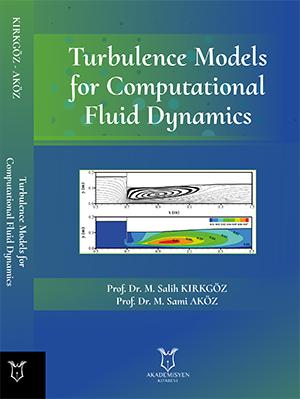
Turbulence Models For Computational Fluid Dynamics
Özet
Turbulent fluid flow is a very complicated natural phenomenon from the viewpoint of both understanding and analysis. Therefore, in turbulent motion studies, besides the theoretical analysis, statistical and empirical correlation methods must also be resorted to. The most fluid flows encountered in industry, especially in aeronautics, and civil, environmental, mechanical, and chemical engineering are turbulent and many phenomena, such as heat or mass transfer, are intimately linked to the fluid motion. In spite of the variety of experimental works on the structure of turbulent flows have so far been conducted, the fundamental mechanisms in turbulence phenomenon still remain incompletely clarified and many problems remain open.
Referanslar
Absi, R. (2006). A roughness and time dependent mixing length equation. Journal of Hydraulic, Coastal and Environmental Eng., Japan Society of Civil Engineers, 62(4), 437-446.
AIAA (1998). Guide for the Verification and Validation of Computational Fluid Dynamics Simulations. American Institute of Aeronautics and Astronautics Guide G- 077-1998.
Aköz, M. S., Gümüş, V. and Kırkgöz, M.S. (2014). Numerical simulation of flow over a semicylinder weir. Journal of Irrigation and Drainage Engineering, ASCE, ISSN 0733-9437/04014016(11).
Ansys Inc. (2011). ANSYS FLUENT Theory Guide, Release 14.0.
Ashgriz, N., Barbat, T. and Wang, G. (2004). A computational Lagrangian-Eulerian advection remap for free surface flows. Int. Journal for Numerical Methods in Fluids, 44(1), 1-32.
Bal, H., Kırkgöz, M. S. and Gümüş, V. (2011). Experimental and numerical modeling of flow over a broad-crested weir. Çukurova University Journal of the Faculty of Engineering and Architecture, 26(2), 33-44.
Balaras, E. and Benocci, C. (1994). Subgrid-scale models in finite-difference simulations of complex wall bounded flows. AGARD CP 551, pp. 2.1-2.5, Neuilly-Sur-Seine, France: AGARD.
Baldwin, B. S. and Barth, T. J. (1990). Thin-layer approximation and algebraic model for separated turbulent flow. AIAA Paper 78-257.
Baldwin, B. S. and Lomax, H. (1978). A One-Equation Turbulence Transport Model for High Reynolds Number Wall-Bounded Flows. NASA TM-102847.
Boussinesq, J. (1877). Théorie de l’écoulement tourbillant. Mém. Prés. Acad. XXIII, 46, Paris.
Bradshaw, P. (1973). Effect of Streamline Curvature on Turbulent Flow. Agardograph Progress No. 169, AGARD.
Cebeci, T. and Smith, A. M. O. (1974). Analysis of Turbulent Boundary Layers. Academic Press, Inc., New York.
Celik, I. B., Ghia, U., Roache, P. J., Freitas, C. J., Coleman H. and Raad, P. R. (2008). Procedure for estimation and reporting of uncertainty due to discretization in CFD applications. J. Fluids Engineering, ASME, 130-078001, 1-4.
Chau, P. Y. (1945). On the velocity correlations and the solution of the equations of turbulent fluctuation. Quart. Appl. Math., 3, 38-54.
Chen, H. C. and Patel, V. C. (1988). Near wall turbulence models for complex flows including separation. AIAA Journal., 26(6), 641-656.
Chien, K. (1982). Predictions of channel and boundary layer flows with a low Reynolds number turbulence model. AIAA Journal, 20, 33-38.
Clauser, F. H. (1954). Turbulent boundary layers in adverse pressure gradients. J. Aeronautical Sciences, 21(2), 91-108.
Clauser, F. H. (1956). The Turbulent Boundary Layer. Advances in Applied Mechanics, 4, 1-51, Academic Press, New York, NY.
Coleman, H. W. and Stern, F. (1997). Uncertainties and CFD code validation. J. Fluids Eng., Trans. ASME, 199, 795-803.
Coles, D. (1956). The law of the wake in the turbulent boundary layer. J. Fluid Mech., 1(2), 191-226.
Coles, D. and Hirst, E. A. (1968). Computation of turbulent boundary layers. 1968 AFOSR- IFP Stanford Conference, Vol. II, Stanford University, CA.
Comte-Bellot, G. (1963). Contribution a l’Etude de la Turbulence de Conduite. PhD Thesis, University of Grenoble, France.
Craft, T. J., Launder, B. E. and Suga, K. (1993). Extending the applicability of eddy viscosity models through the use of deformation invariants and nonlinear elements. 5th IAHR Conf. on Refined Flow Modeling and Turbulence Measurements, Presse Ponts et Chaussées, 125-132, Paris.
Craft, T. J., Launder, B. E. and Suga, K. (1996). Development and application of a cubic eddy-viscosity model of turbulence. Int. Journal of Heat and Fluid Flow, 17(2), 108-115. Daly, B. J. and Harlow, F. H. (1970). Transport equations in turbulence. Phys. of Fluids, 13, 2634-2649.
Davidson, L. (2010). Fluid Mechanics, Turbulent Flow and Turbulence Modeling. Dept. Applied Mechanics, Chalmers University of Technology, Göteborg, Sweden.
Degani, D. and Schiff, L. B. (1986). Computation of turbulent supersonic flows around pointed bodies having crossflow separation. Journal of Computational Physics, 66(1), 173-196.
Demuren, A. O. and Rodi, W. (1984). Calculation of turbulence-driven secondary motion in non-circular ducts. J. Fluid Mech., 140, 189-220.
Demuren, A. O. (1991). Calculation of turbulence-driven secondary motion in ducts with arbitrary cross section. AIAA Journal, 29(4), 531-537.
Donaldson, C. du P. (1972). Construction of a Dynamic Model of the Production of Atmospheric Turbulence and the Dispersal of Atmospheric Pollutants. ARAP Report 175, Aeronautical Research Associates of Princeton, Princeton, NJ.
Durbin, P. A. (1991). Near wall turbulence modeling without damping function. J. Theor. and Comput. Fluid Dynamics, 3, 1-13.
Emmons, H. W. (1954). Shear flow turbulence. Proc. of the 2nd U. S. Congress of Applied Mechanics, ASME.
Escudier, M. P. (1966). The distribution of mixing-length in turbulent flows near walls. Imp. Coll. Heat Transfer Section Rep. TWF/TN/1.
Favre, A., Kovasznay, L. S. G., Dumas, R., Gaviglio, J. and Coantic, M. (1976). La Turbulence En Mécanique Des Fluides. Bases Théoriques Et Expérimentales. Gauthier- Villars, Paris.
Fletcher, C. A. J. (1991). Computational Techniques for Fluid Dynamics. Vols. I and II, Springer-Verlag, Berlin.
Gatski, T. B. and Speziale, C. G. (1993). On explicit algebraic stress models for complex turbulent flows. Journal of Fluid Mechanics, 254, 47-83.
Germano, M., Piomelli, U., Moin, P. and Cabot, W. (1990). A Dynamic subgrid-scale eddy viscosity model. Proc. 1990 Summer Program, Center for Turbulence Research, Stanford Univ., CA.
Germano, M., Piomelli, U., Moin, P. and Cabot, W. (1991). A Dynamic subgrid-scale eddy viscosity model. Physics of Fluids A, 3(7), 1760-1765.
Gibson, M. M. and Launder, B. E. (1978). Ground effects on pressure fluctuations in the atmospheric boundary layer. J. Fluid Mechanics, 86(3), 491-511.
Girimaji, S. S. (1996). Fully-explicit and self-consistent algebraic Reynolds stress model. Theoretical and Computational Fluid Dynamics, 8(6), 387-402.
Glushko, G. (1965). Turbulent boundary layer on a flat plate in an incompressible fluid. Izvestia Akademiya Nauk SSSR, Mekh., No. 4, p. 13.
Gümüş V., Aköz, M. S. and Kırkgöz, M. S. (2013). Experimental and numerical modeling of submerged hydraulic jump downstream of a sluice gate. İMO Teknik Dergi, Yazı 399, 6379-6397.
Gümüş, V., Soydan, N. G., Şimşek, O., Kırkgöz, M. S. and Aköz, M. S. (2015). Experimental and numerical modeling of flow over a spillway. Proc. of the 2nd Int. Conf. on Advances in Civil, Structural and Construction Eng. CSCE 2015, 55-59.
Gümüş, V., Şimşek, O., Soydan, N. G., Aköz, M. S. and Kırkgöz, M. S. (2015). Numerical modeling of submerged hydraulic jump from a sluice gate. Journal of Irrigation and Drainage Engineering, ASCE, ISSN 0733-9437/04015037(11).
Güzel, H. (1991). Investigation of Energy Loss in a Dam Spillway Channel. MSc Thesis (in Turkish), Çukurova University, Adana, Turkey.
Hanjalic, K. (2005). Will RANS survive LES? A view of perspectives. J. Fluids Eng. 127, 831-839.
Hanjalic, K. and Launder, B. E. (1972). A Reynolds stress model of turbulence and its application to thin shear flow. J. Fluid Mech., 52(4), 609-625.
Hanjalic, K. and Launder, B. E. (1976). Contribution towards a Reynolds stress closure for low Reynolds number turbulence. J. Fluid Mech., 74, 593-610.
Hanjalic, K., Popovac, M. and Hadziabdic, M. (2004). A robust near-wall elliptic relaxation eddy-viscosity turbulence model for CFD. Int. J. Heat and Fluid Flow, 25, 1047-1051.
Hinze, J. O. (1975). Turbulence. 2nd ed., McGraw-Hill, New York, NY.
Hirt, C. V. and Nichols, B. D. (1981). Volume of fluid method for the dynamics of free boundaries. Journal of Computational Physics, 39(1), 201-225.
Horiuti, K. (1990). Higher-order terms in the anisotropic representation of Reynolds stresses. Physics of Fluids A: Fluid Dynamics, 2, 1708.
Issa, R. I. (1986). Solution of the implicitly discretized fluid flow equations by operator- splitting. J. Comput. Phys., 62, 40-65.
Jones, W. P. and Launder, B. E. (1972). The prediction of laminarization with a two- equation model of turbulence. Int. Journal of Heat and Mass Transfer, 15, 301-314.
Jongen, T. (1992). Simulation and Modeling of Turbulent Incompressible Flows. PhD thesis, EPF Lausanne, Lausanne, Switzerland.
Kato, M. and Launder, B. E. (1993). The modeling of turbulent flow around a stationary and vibrating square cylinder. Proc. 9th Symp. on Turbulent Shear Flows, Kyoto, Japan, Vol. 9, pp. 10.4/1-10.4/6.
Kırkgöz, M. S. (1989). Turbulent velocity profiles for smooth and rough open channel flow. J. Hyd. Eng., ASCE, 115(11), 1543-1561.
Kırkgöz, M. S. and Ardıçlıoğlu, M. (1997). Velocity profiles of developing and developed open channel flow. J. Hyd. Eng., ASCE, 123(12), 1099-1105.
Kırkgöz, M. S., Aköz, M. S. and Öner, A. A. (2009). Numerical modeling of flow over a chute spillway. Journal of Hydraulic Research, 47(6), 790-797.
Kırkgöz, M. S., Aköz, M. S., Gümüş, V. and Öner, A. A. (2011). Experimental and numerical modeling of flow over a gate-controlled broad-crested weir. Proc. 5th National Water Engineering Symposium, 12-16 Sept., İstanbul, 611-624.
Kırkgöz, M. S., Gümüş, V., Soydan, N. G., Şimşek, O. and Aköz, M. S. (2012). Experimental and numerical modeling of flow over a gate-controlled semicylinder weir. 10th Int. Congress on Advances in Civil Engineering, 17-19 October, METU, Ankara, 0184, 1-10.
Kim, J., Moin, P. and Moser, R. (1987). Turbulence statistics in fully developed channel flow at low Reynolds number. J. Fluid Mech., 177, 133-166.
Kim, W. W. and Menon, S. (1994). A new dynamic one equation subgrid scale model for large eddy simulations. AIAA Paper No. 95-0356.
Klebanoff, P. S. (1954). Characteristics of turbulence in a boundary layer with zero pressure gradient. NACA Report 3178, Washington, DC.
Klebanoff, P. S. (1955). Characteristics of turbulence in a boundary layer with zero pressure gradient. NACA Report 1247, Washington, DC.
Kline, S. J., Morkovin, M. V., Sovran, G. and Cockrell, D. J. (1969). Computation of turbulent boundary layers. 1968 AFOSR-IFP Stanford Conference, Vol. I, Stanford University, CA.
Kok, J. C., Dol, H. S., Oskam, B. and van der Ven, H. (2004). Extra-large eddy simulation of massively separated flows. AIAA paper 2004-264, Reno, NV.
Kolmogorov, A. N. (1941). Local structure of turbulence in incompressible viscous fluid for very large Reynolds number. Doklady Akademiya Nauk SSSR, 30, 299-303.
Kolmogorov, A. N. (1942). Equations of turbulent motion of an incompressible fluid. Izvestia Academy of Sciences, USSR; Physics, 6 (1 and 2), 56-58.
Kraichnan, R. H. (1991). Turbulent cascade and intermittency growth. Proc. Royal Society of London, Mathematical and Physical Sciences, A434 (1890), 65-78.
Lam, C. K. G. and Bremhorst, K. (1981). A modified form of the k- model for predicting wall turbulence. J. of Fluid Engng., 103(3), 456-460.
Landahl, M. T. and Mollo-Christensen, E. (1992). Turbulence and Random Processes in Fluid Mechanics. Second Ed., Cambridge University Press, New York, NY.
Langtry, R. B. and Menter, F. R. (2009). Correlation-based transition modeling for unstructured parallelized computational fluid dynamics codes. AIAA Journal, 47(12), 2894-2906.
Laufer, J. (1951). Investigation of Turbulent Flow in a Two-Dimensional Channel. NACA Report 1053.
Launder, B. E. and Jones, W. P. (1969). A note on Bradshaw’s hypothesis for laminarization. ASME Paper 69-HT-12.
Launder, B. E. and Spalding, D. B. (1972). Mathematical Models of Turbulence. Academic Press, London.
Launder, B. E. and Sharma, B. I. (1974). Application of the energy dissipation model of turbulence to the calculation of flow near a spinning disc. Letters in Heat and Mass Transfer, 1(2), 131-138.
Launder, B. E. and Spalding, D. B. (1974). The numerical computation of turbulent flows. Computer Methods in Applied Mechanics and Energy, 3, 269-289.
Launder, B. E., Reece, G. J. and Rodi, W. (1975). Progress in the development of a Reynolds stress turbulence closure. J. Fluid Mech., 68(3), 537-566.
Launder, B. E. (1989). Second moment closure: present and future. Int. J. Heat and Fluid Flow, 10(4), 282-300.
Launder, B. E. and Shima, N. (1989). Second moment closure for the near wall sublayer: development and application. AIAA Journal, 27(10), 1319-1325.
Launder, B. E. (1993). Modelling convective heat transfer in complex turbulent flows. Proc. of the 2nd Int. Symp. on Engineering Turbulence Modelling and Measurements, Florence, Italy, 3-22.
Leonard, A. (1974). Energy cascade in large-eddy simulations of turbulent fluid flows. Advances in Geophysics, 18A, 237-248.
Libby, P. A. (1996). Introduction to Turbulence. Taylor and Francis, Bristol, PA.
Lien, F. S. and Leschziner, M. A. (1994). Assessment of turbulence-transport models including non-Linear RNG eddy-viscosity formulation and second-moment closure for flow over a backward-facing step. Computers and Fluids, 23, 983-1004.
Lien, F. S., Chen, W. L. and Leschziner, M. A. (1996). Low-Reynolds number eddy- viscosity modelling based on non-linear stress-strain/vorticity relations. Proc. 3rd Symp. on Engineering Turbulence Modelling and Measurements, Crete, Greece.
Lilly, D. K. (1966). On the Application of the Eddy Viscosity Concept in the Inertial Subrange of Turbulence. NCAR Manuscript 123.
Lilly, D. K. (1992). A proposed modification of the Germano subgrid scale closure model. Phys. of Fluids A, 4(3), 633-635.
Lindgren, E. R. (1965). Experimental study on turbulent pipe flows of distilled water. Civil Eng. Dept., Oklahoma State University, Rept. IAD621071.
Lumley, J. L. (1970). Toward a turbulent constitutive equation. Journal of Fluid Mechanics, 41, 413-434.
Lumley, J. L. and Newman, G. R. (1977). The return to isotropy of homogeneous turbulence. J. Fluid Mech., 82(1), 161-178.
Lumley, J. L. (1978). Computational modeling of turbulent flows. Adv. Appl. Mech., 18, 123-176.
Mellor, G. L. and Gibson, D. M. (1966). Equilibrium turbulent boundary layers. J. Fluid Mechanics, 24, Part 2, 225-253.
Mellor, G. L. and Herring, H. J. (1973). A survey of mean turbulent field closure models. AIAA Journal, 11(5), 590-599.
Menter, F. R. (1994). Two-equation eddy-viscosity turbulence models for engineering applications. AIAA Journal, 32(8), 1598-1605.
Menter, F. R., Kuntz, M. and Langtry, R. (2003). Ten years of industrial experience of the SST turbulence model. In: Hanjalic, K., Nagano, Y. and Tummers, M. J. (Eds.), Turbulence, Heat and Mass Transfer 4, 624-632, New York, Wallingford (UK).
Menter, F. R., Langtry, R. B., Likki, S. R., Suzen, Y. B., Huang, P. G. and Volker, S. (2004). A Correlation Based Transition Model Using Local Variables, Part 1 - Model Formulation. ASME-GT2004-53452.
Moser, R. D. and Moin, P. (1984). Direct Numerical Simulation of Curved Turbulent Channel Flow. NASA TM-85974.
Naot, D. and Rodi, W. (1982). Numerical simulations of secondary currents in channel flow. J. Hyd. Div., ASCE, 108(HY8), 948-968.
Nezu, I. and Nakagawa, H. (1993). Turbulence in Open-Channel Flows. A. A. Balkema Publishers, Rotterdam, Netherlands.
Nicoud, F. and Ducros, F. (1999). Subgrid-scale stress modelling based on the square of the velocity gradient tensor. Flow, Turbulence and Combustion, 62(3), 183-200.
Nikuradse, J. (1933). Stromungsgesetze in rauhen Rohren. VDI-Forschungsheft, 361.
Oberkampf, W. L. and Trucano, T. G. (2002). Verification and validation in computational fluid dynamics. Prog. Aerosp. Sci., 38, 209-272.
Oner, A. A., Aköz, M. S., Kırkgöz, M. S. and Gümüş, V. (2012). Experimental validation of volume of fluid method for a sluice gate flow. Advances in Mechanical Engineering, Article ID 461708.
Park, T. S. and Sung, H. J. (1997). A new low-Reynolds number k--f model for predictions involving multiple surfaces. Fluid Dynamics Research, 20, 97-113.
Patankar, S. V. (1980). Numerical Heat Transfer and Fluid Flow. Hemisphere Publishing Corp., Taylor & Francis Group, New York.
Patankar, S. V. and Spalding, D. B. (1970). Heat and Mass Transfer in Boundary Layers, A General Calculation Procedure. Intertext Books, London.
Patankar, S. V. and Spalding, D. B. (1972). A calculation procedure for heat, mass and momentum transfer in three-dimensional parabolic flows. Int. J. Heat Mass Transfer, 15(10), 1787-1806.
Patel, V. C., Rodi, W. and Scheuerer, G. (1985). Turbulence models for near-wall and low Reynolds number flows: A review. AIAA Journal, 23(9), 1308-1319.
Patel, V. C. (1988). Perspective: flow at high Reynolds number and over rough surfaces- achilles heel of CFD. J. Fluids Engng., 120(3), 434-444.
Prandtl, L. (1904). Über Flüssigkeitsbewegung bei sehr Kleiner Reibung. Proc. Third Internat. Math. Cong. Heidelberg.
Prandtl, L. (1925). Über die ausgebildete Turbulenz. ZAMM 5, 136-139.
Prandtl, L. (1933). Neuere Ergebnisse der Turbulenzforschung. Z. VDI 77, 105-114. Prandtl, L. (1945). Über ein neues Formelsystem für die ausgebildete Turbulenz. Nachr.
Akad. Wiss. Göttingen, Math-Phys. Kl. II., 6-19.
Raudkivi, A. J. and Callander, R. A. (1975). Advanced Fluid Mechanics. Edward Arnold Publishers Ltd., London.
Reynolds, O. (1883). An experimental investigation of the circumstances which determine whether the motion of water shall be direct or sinuous, and of the laws of resistance in parallel channels. Phil. Trans. Royal Society of London, A174, 935-982.
Reynolds, O. (1895). On the dynamical theory of incompressible viscous fluids and the determination of the criterion. Philosophical Transactions of the Royal Society of London, Series A, 186, 123-164.
Reynolds, W. C. (1987). Fundamentals of Turbulence for Turbulence Modeling and Simulation. In: Lecture Notes for von Karman Institute, AGARD Lecture Series No. 86, 1-66, New York: NATO.
Richardson, L. F. (1910). The approximate arithmetical solution by finite differences of physical problems involving differential equations, with an application to the stresses in a masonry dam. Phil. Trans. Roy. Soc. London, Ser. A, 210, 307-357.
Richardson, L. F. and Gaunt, J. A. (1927). The deferred approach to the limit. Phil. Trans.
Roy. Soc. London, Ser. A, 226, 299-361.
Rodi, W. (1976). A new algebraic relation for calculating the Reynolds stresses. ZAMM, 56, 219-221.
Rodi, W. (1980). Turbulence models and their application in hydraulics. Conf. IARH- Section on Fundamentals of Division II. Exp. and Math. Fluid Dynamics, Delft.
Roache, P. J. (1997). Quantification of uncertainty in computational fluid dynamics. Annual Review of Fluid Mechanics, 29, 123-160.
Roache, P. J. (1998). Verification of codes and calculations. AIAA Journal, 36(5), 696- 702.
Rotta, J. C. (1951). Statistische Theorie nichthomogener Turbulenz. Zeitschrift für Physik. 129, 547-572.
Rotta, J. C. (1956). Experimenteller Beitrag zur Entstehung turbulenter Stromungen im Rohr. Ing.-Arch., 24, 258-281.
Rotta, J. C. (1968). Über eine Methode zur Berechnung turbulenter Scherströmungen. Aerodynamische Versuchanstalt Göttingen, Rep. 69 A 14.
Rubinstein, R. and Barton, J. M. (1990). Nonlinear Reynolds stress models and renormalization group. Physics of Fluids, A2(8), 1472-1476.
Saffman, P. G. (1976). Development of a complete model for the calculation of turbulent shear flows. Symposium on Turbulence and Dynamical Systems, Duke Univ., Durham, NC.
Schiestel, R. (2008). Modeling and Simulation of Turbulent Flows. ISTE Ltd. and John Wiley & Sons, Inc., London.
Schlichting, H. (1933). Laminare Strahlenausbreitung. Z. Angew Math. Mech., 13, 260- 263.
Schumann, U. (1977). Realizability of Reynolds-stress turbulence models. The Physics of Fluids, 20(5), 721-725.
Shaanan, S., Ferziger, J. H. and Reynolds, W. C. (1975). Numerical Simulation of Turbulence in the Presence of Shear. Report No. TF-6, Dept. of Mech. Eng., Stanford University, CA.
Shih, T. H. and Lumley, J. L. (1993). Critical comparison of second order closures with direct numerical simulations of homogeneous turbulence. AIAA Journal, 31(4), 663- 670.
Shih, T. H., Zhu, J. and Lumley, J. L. (1994). A New Reynolds Stress Algebraic Equation Model. NASA Technical Memorandum 106644.
Shih, T. H., Zhu, J. and Lumley, J. L. (1995). A new Reynolds stress algebraic equation model. Computer Methods in Applied Mechanics and Engng., 125(1-4), 287-302.
Shih, T. H., Liou, W. W., Shabbir, A., Yang, Z. and Zhu, J. (1995). A new k- eddy viscosity model for high Reynolds number turbulent flows. Computers and Fluids, 24(3), 227-238.
Smagorinsky, J. (1963). General circulation experiments with the primitive equations. I. The basic experiment. Mon. Weather Rev., 91, 99-164.
Smith, A. M. O. and Cebeci, T. (1967). Numerical Solution of the Turbulent Boundary- Layer Equations. Douglas Aircraft Division Report DAC 33735.
So, R. M. C., Lai, Y. G., Zhang, H. S. and Hwang, B. C. (1991). Second-order near-wall turbulence closures: a review. AIAA Journal, 29(11), 1819-1835.
Soydan-Oksal, N. G., Aköz, M. S. and Şimşek, O. (2020). Numerical modeling of trapezoidal weir flow with RANS, LES and DES models. Sadhana, 45:91, Indian Academy of Sciences.
Spalart, P. R. and Allmaras, S. R. (1992). A one-equation turbulence model for aerodynamic flows. AIAA Paper 92-439, Reno, NV.
Spalart, P. R., Jou, W. H., Strelets, M. and Allmaras, S. R. (1997). Comments on the feasibility of LES for wings, and on a hybrid RANS/LES approach. Proc. 1st AFOSR Int. Conf. on DNS and LES, Louisiana Tech., Greyden Press, Columbus, OH.
Spalding, D. B. (1961). A single formula for the law of the wall. J. Appl. Mech., E28, 455- 458.
Spalding, D. B. (1969). The calculation of the Length Scale of Turbulence in Some Shear Flows Remote from Walls. Progress in Heat and Mass Transfer, Vol. 2, Pergamon Press London.
Speziale, C. G. (1987). On non-linear k-l and k- models of turbulence. J. Fluid Mech., 178, 459-475.
Speziale, C. G., Abid, R. and Anderson, E. C. (1990). A critical evaluation of two-equation models for near wall turbulence. AIAA Paper 90-1481, Seattle, WA.
Speziale, C. G. (1991). Analytical methods for the development of Reynolds stress closures in turbulence. Annual Review of Fluid Mechanics, 23, 107-157.
Speziale, C. G., Sarkar, S. and Gatski, T. B. (1991). Modeling the pressure-strain correlation of turbulence: An invariant dynamic system approach. J. Fluid Mech., 227, 245-272.
Speziale, C. G., Gatski, T. B. and Sarkar, S. (1992). On testing models for the pressure- strain correlation of turbulence using direct simulations. Phys. of Fluids A, 4(12), 2887- 2899.
Sümer, B. M. (2007). Lecture Notes on Turbulence. Technical University of Denmark, MEK, Coastal, Maritime & Structural Engineering Section, Lyngby, Denmark.
Şimşek, O., Soydan, N. G., Gümüş, V., Aköz, M. S. and Kırkgöz, M. S. (2015). Numerical modeling of B-type hydraulic jump at an abrupt drop. İMO Teknik Dergi, Yazı 441, 7215-7240.
Şimşek, O., Aköz, M. S. and Soydan, N. G. (2016). Numerical validation of open channel flow over a curvilinear broad-crested weir. Progress in Computational Fluid Dynamics, 16(6), 364-378.
Taylor, G. I. (1935). Statistical theory of turbulence. Proc. Royal Society of London, A151, 421-435.
Taylor, G. I. (1938). The spectrum of turbulence. Proc. Royal Society of London, Mathematical and Physical Sciences, A164, 476-490.
Tennekes, H. and Lumley, J. L. (1972). A First Course in Turbulence. MIT Press, Cambridge, Massachusetts.
Tessicini, F., Li, N. and Leschziner, M. A. (2005). Zonal LES/RAN modelling of separated flow around a three-dimensional hill. ERCOFTAC Workshop Direct and Large-Eddy Simulation 6, Poitiers.
Thompson, B. and Whitelaw, J. (1985). Characteristics of a trailing-edge flow with turbulent boundary-layer separation. J. Fluid Mech., 157, 305-326.
Tollmien, W. (1931). Grenzschichttheorie. In: Handbuch der Experimentalphysik IV,1, Leipzig, 239–287.
Travin, A. K., Shur, M., Strelets, M. and Spalart P. R. (2002). Physical and numerical upgrades in the detached-eddy simulations of complex turbulent flows. In: Friederich,
R. and Rodi, W. (Eds.), Fluid Mechanics and its Applications, Advances in LES of Complex Flows, 239-254, Academic Publishers, Dordrecht.
van Doormal, J. P. and Raithby, G. D. (1984). Enhancements of the SIMPLE method for predicting incompressible fluid flows. Numerical Heat Transfer, 7, 147-163.
van Driest, E. R. (1956). On turbulent flow near a wall. J. Aero. Sci., 23, 1007-1011. Versteeg, H. K. and Malalasekera, W. (2007). An Introduction to Computational Fluid Dynamics. Pearson Education Ltd., London.
von Karman, T. (1930). Mechanische Ahnlichkeit und Turbulenz. Nah. Ges. Wiss. Göttingen, Math. Phys. Klasse, 58.
von Karman, T. (1934). Turbulence and skin friction. J. Aeronautical Sciences, 1(1), 1-20. von Karman, T. and Howarth, L. (1938). On the statistical theory of isotropic turbulence. Proc. Royal Society of London, Mathematical and Physical Sciences, A164 (917), 192-215.
Walters, D. K. and Cokljat, D. (2008). A three-equation eddy-viscosity model for Reynolds- averaged Navier-Stokes simulations of transitional flows. Journal of Fluids Engineering, 130.
White, F. M. (1991). Viscous Fluid Flow. McGraw-Hill, Inc., New York.
Wilcox, D. C. (1988a). Reassessment of the scale-determining equation for advanced turbulence models. AIAA Journal, 26(11), 1299-1311.
Wilcox, D. C. (1988b). Multiscale model for turbulent flows. AIAA Journal, 26(11), 1311- 1320.
Wilcox, D. C. (1994). Simulation of transition with a two-equation turbulence model.
AIAA Journal, 32(2), 247-255.
Wilcox, D. C. (1998). Turbulence Modeling for CFD. DCW Industries, Inc., La Canada, California.
Wilcox, D. C. (2000). Turbulence Modeling for CFD. KNI, Inc., Anaheim, California. Wolfshtein, M. (1967). Convection Processes in Turbulent Impinging Jets. Imperial College, Heat Transfer Section Report SF/R/2, London.
Wolfshtein, M. (1969). The velocity and temperature distribution in one-dimensional flow with turbulence augmentation and pressure gradient. Int. J. Heat and Mass Transfer, 12, 301-318.
Yakhot, V. and Orszag, S. A. (1986). Renormalization group analysis of turbulence: 1.
Basic theory. Journal of Scientific Computing, 1, 3-51.
Yakhot, V., Orszag, S. A. and Panda, R. (1989). Computational test of renormalization group theory of turbulence. C. C. Chau et al. (eds.), Recent Advances in Computational Fluid Dynamics, Springer-Verlag Berlin, Heidelberg.
Yakhot, V., Orszag, S. A., Thangam, S., Gatski, T. B. and Speziale, C. G. (1992). Development of turbulence models for shear flows by a double expansion technique. Physics of Fluids A, 4, 1510-1520.
Yan, J., Mocket, C. and Thiele, F. (2005). Investigation of alternative length scale substitutions in detached-eddy simulation. Flow, Turbulence and Combustion, 74, 85- 102.
Yap, C. (1987). Turbulent Heat and Momentum Transfer in Recirculating and Impinging Flows. PhD Thesis, University of Manchester and UMIST, Dept. of Mech. Eng. Report TFD/87/1.
Zeierman, S. and Wolfshtein, M. (1986). Turbulent time scale for turbulent flow calculations. AIAA Journal, 24(10), 1606-1610.
Yayınlanan
Lisans
LisansBu İnternet Sitesi içeriğinde yer alan tüm eserler (yazı, resim, görüntü, fotoğraf, video, müzik vb.) Akademisyen Kitabevine ait olup, 5846 sayılı Fikir ve Sanat Eserleri Kanunu ve 5237 sayılı Türk Ceca Kanunu kapsamında korunmaktadır. Bu hakları ihlal eden kişiler, 5846 sayılı Fikir ve Sanat eserleri Kanunu ve 5237 sayılı Türk Ceza Kanununda yer alan hukuki ve cezai yaptırımlara tabi olurlar. Yayınevi ilgili yasal yollara başvurma hakkına sahiptir.
