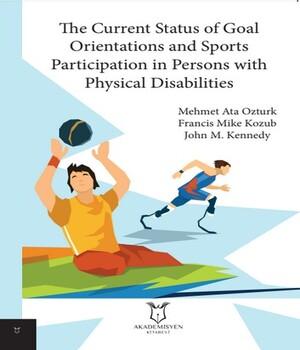
The Current Status of Goal Orientations and Sports Participation in Persons with Physical Disabilities
Özet
There are many people who contributed to this dissertation. Their support was priceless for the finalization of this project and deserves recognition. Above all, one person deserves the most; my wife, Seran Ozturk. Words can never express well enough, her continued support for finishing this dissertation. She not only kept me motivated but also supported me in data collection, and proofreading of this dissertation. She patiently listened, wisely commented, and generously shared her thoughts to make this project a better one. From the academia, I would like to first state my gratitude to Dr. Francis M. Kozub for serving as my dissertation chair, and also for being my academic advisor in this doctoral program. I always benefited from our thought-provoking meetings, his comprehensive comments and propositions both for this project and others. He always cultivated a high-quality research mentality that I will always hang on to. I also want to express my appreciation to Dr. Georgia Frey for her support in improving this dissertation. She provided me with great opportunities throughout my doctoral studies to improve my knowledge and skills in adapted physical education. For shaping of the instrument, and for finalizing the data collection procedures, I am grateful to Dr. John Kennedy. His expertise in survey research methodology as the director of Center for Survey Research at Indiana University, undoubtedly helped for a successful data collection and an overall smooth-going process. Another great aid for this project was Dr. David Koceja. Especially before the dissertation proposal, I felt his significant support in constructing this great committee. The things that I learned in his statistics courses, has been priceless when I was working on the data analysis. The last person that I want to thank from my committee, but not the least is my minor advisor. Dr. Samuel Odom, the director of Child Development Institute at the University of North Carolina, Chapel Hill has been kind to provide me support from a distance. I am really pleased for his presence in this committee. He is another great instructor in helping with my research skills through the graduate courses he offered while he was affiliated with Indiana University. I also want to thank Dr. Claudine Sherrill, professor-emeritus of the Texas Woman’s University in Denton. While I was feeling lost and desperate, she offered a helping hand and took the time to read my draft and provided comments to improve the study. It was an honor to feel her belief in me and her encouragement. This section would not be complete without cordial thanks to Dr. Hilmi Demir, assistant professor of philosophy at California State University, San Bernardino. He spared his valuable time for helping me during the instrument development. Additionally, I want to reveal my sincere appreciation to the panel of experts who revived the instrument in order to fine tune before the conduct of pilot study. There is one group of people who had the biggest contribution to this study. I would like to thank all the athletes for participating; all the administrators, coaches, and event coordinators for allowing me to collect data at their facilities and at tournaments. Without them, this study could not be done. The dissertation was partially funded by Indiana University School of HPER. I was honored that the study was seen to be worthy of support. Also, Turkish Ministry of National Education provided me financial support for graduate studies in U.S. I am thankful all that they bestowed with their financial support. A few people deserve special thanks. I would like to thank my parents, Ulker and Ali Ihsan Ozturk for raising me and providing me with an excellent education, which prepared me for studying in U.S. I want to express gratitude to my brothers Murat Halil and Mustafa Kemal Ozturk for helping keep my peace of mind during this long process. I have always felt the support of my parents in law, Bilge and Aziz Fehmi and my brother in law, Serkan Fehmi. They gave full support during the last years of my graduate studies to make me feel at home in North America.
Referanslar
Aiken, L. R. (1985). Three coefficients for analyzing the reliability and validity of ratings. Educational and Psychological Measurement, 45, 131-142.
American Academy of Pediatrics (2001). Organized sports for children and preadolescents. Pediatrics, 107, 1459-1462.
American Academy of Pediatrics (2000). Physical fitness and activity in schools. Pediatrics, 105, 1156-1157.
Ames, C. (1992). Classrooms: Goals, structures, and student motivation. Journal of Educational Psychology, 84, 261-271.
Australian Sports Commission. Retrived October 2, 1997, from http://www. ausport.gov.au/aisaus.html
Ayvazoglu, N., Oh, H., & Kozub, F. M. (2006). Explaining physical acti- vity in children with visual impairments: A family systems approach. Exceptional Children, 72, 235-248.
Bergin, D. A., & Habusta, S. F. (2004). Goal orientations of young male ice hockey players and their parents. The Journal of Genetic Psychology, 165, 383-397.
Bhambani, Y., Burnham, R., Wheeler, G., Eriksson, P., Holland, L., & Steadward, R. (1995). Ventilatory threshold during wheelchair exercise in untrained and endurance-trained subjects with quadriplegia. Adapted Physical Activity Quarterly, 12, 333-343.
Brandi-Bredenbeck, H. P., & Brettschneider, W.D. (1997). Sport involvement and self-concept in German and American adolescents. International Review for the Sociology of Sport, 32, 357-371.
Bredeimer, B., & Shields, D. (1993). Moral Psychology in the context of sport. In R. N. Singer, M. Murphey, & M. R. Weiss (Eds.), Handbook of research in sport psychology. New York: Macmillan.
Brittain, I. (2004). The role of schools in constructing self-perceptions of sport and physical education in relation to people with disabilities. Sport, Education & Society, 9, 75-94.
Brittain, I. (2002). Perspectives of elite athletes with disabilities: Problems and possibilities. Doctoral dissertation, Brunel University, UK.
Brunel, P. C. (1999). Relationship between achievement goal orientations and perceived motivational climate on intrinsic motivation. Scandinavian Journal of Medicine & Science in Sports, 9, 365-374.
Brustad, R. J. (1992). Integrating socialization influences into the study if children’s motivation into sport. Journal of Sport and Exercise Psychology, 14, 59-77.
Brustad, R. J., Babkes, M. L.,& Smith, A. L. (2001). Youth in sport: Psychological considerations. In R. N. Singer, H. A. Hausenblas, & C. M. Janelle. (Eds.), Handbook of sport psychology (2nd ed.; pp.604-635). New York: John Wiley & Sons.
Campbell, I. G., Williams, C., Lakomy, H K. A. (1997). Physiological respon- ses to wheelchair athletes at percentages of top speed. British Journal of Sports Medicine, 31, 36-40.
Chi, L. & Duda, J. L. (1995). Multi sample confirmatory factor analysis of the task and ego orientation in sport questionnaire. Research Quarterly for Exercise and Sport, 66, 91-98.
Coakley, J. (2004). Sport in society. Issues and controversies (8th ed.). Boston, MA: McGraw-Hill.
Coakley, J. (1993). Socialization and sport. In R. N. Singer, M. Murphey, & M. R. Weiss
(Eds.), Handbook of research in sport psychology. New York: Macmillan. Coakley, J., & White, A. (1992). Making decisions: gender and sport participation among British adolescents. Sociology of Sport Journal, 9, 20-35. Committee on Sports Medicine and Fitness and Committee on School Health.(2001).
Organized sports for children and preadolescents. Pediatrics, 107, 1459-1462. Cronbach, L. J. (1951). Coefficient alpha and internal structure of tests. Pyschometrica, 16, 297-334.
Cury F., Biddle, S. J. H., Famose, J. P., Goudas, M., Sarrazin, P., & Durand, M. (1996). Personal and situational factors influencing intrinsic interest of adolescent girls in school physical education: a structural equation mo- deling analysis. Educational Psychology, 16, 305-315.
Curtis, K. A., McClanahan, S., Hall, K. M., Dillon, D., & Brown, K. F. (1986). Health, vocational, and functional status in spinal cord injuried athletes and non-athletes. The Archives of Physical Medicine and Rehabilitation, 67, 862-865.
Darcy, S. A. (2003) Retrieved July 22, 2006, from http://www.daaa.org/ Darcy, S.A. (2003). Disabling journeys: the social relations of tourism for people with impairments in Australia - an analysis of government tourism authorities and accommodation sector practice and discourses. Unpublished doctoral dissertation, University of Technology, Sydney.
Deci, E. L., & Ryan, R. M. (1985). Intrinsic motivation and self-determination in human behavior. New York: Plenum.
DePauw, K., & Gavron, S. (2005). Disability sport (2nd ed.). Champaign, IL: Human Kinetics.
Doll-Tepper, G. (1998). International perspectives on research in adapted physical activity. Paper presented at the AlESEP World Congress, Garden City. New York, July 13-17.
Duda, J. L. (2001). Achievement goal research in sport: Pushing the boun- daries and clarifying some misunderstandings. In G. C. Roberts (Ed.) Advances in motivation in sport and exercise. (pp.1-51). Champaign, IL: Human Kinetics.
Duda, J. L., Chi, L., Newton, M. L., Walling, M. D., & Catley, D. (1995). Task and ego orientation and intrinsic motivation in sport. International Journal of Sport Psychology, 26, 40-63.
Duda, J. L., Fox, K. R., Biddle, S. J., & Armstrong, N. (1992). Children’s ac- hievement goals and beliefs about success in sport. British Journal of Educational Psychology, 62, 313-323.
Duda, J. L., & Nicholls, J. G. (1992). Dimensions of achievement motivation in schoolwork and sport. Journal of Educational Psychology, 84, 290-299. Duda, J. L. (1989). Relationship between task and ego orientation and the perceived purpose of sport among high school athletes. Journal of Sport & Exercise Psychology, 11, 318-335.
Duda, J L., & Whitehead, J. (1998). Measurement of goal perspectives in the physical domain. In J. Duda (Ed.), Advances in sport and exercise psycho- logy measurement (pp. 21-48). Morgantown, WV: Fitness Information Technology.
Duda, J. L., & White, S. A. (1992). Goal orientations and beliefs about the cau- ses of sport success among elite skiers. The Sport Psychologist, 6, 334-343. Dunn, J C. (2000). Goal orientations, perceptions of the motivational clima- te, and perceived competence of children with movement difficulties.
Adapted Physical Activity Quarterly, 17, 1-19.
Dunn, J. G H., Bouffard, M, & Rogers, W T. (1999). Assessing content-re- levance in sport psychology scale-construction research: Issues and recommendations. Measurement in Physical Education and Exercise Science, 3, 15-36.
Dweck, C. S., & Leggett, E. (1988). A social cognitive approach to motivation and personality. Psychological Review, 95, 256-273.
Ewing, M. (1981). Achievement motivation and sport behavior of males and females.
Unpublished doctoral dissertation, University of Illinois, Urbana-Champaign. Ferrara, M. S., Palutsis, G. R., Snouse, S., & Davis, R. W. (2000). A longitudi- nal study of injuries to athletes with disabilities. International Journal of
Sports Medicine, 21, 221-224.
Ford, M. (1992). Motivating humans: Goals, emotions, and personal agency beliefs.Boston: Sage.
Foster, C., Hillsdon, M., Cavil, N., Allender, S., & Cowburn, G. (2005). Understanding participation in sport – a systematic review. Oxford, England: University of Oxford, British Heart Foundation Health Promotion Research Group.
Fox, K., Goudas, M., Biddle, S., Duda, J., Armstrong, N. (1994). Children’s task and ego profiles in sport. British Journal of Educational Psychology, 64, 253-261.
Fung, L. (1992). Participation motives in competitive sports: a cross cultural comparison. Adapted Physical Activity Quarterly, 9, 114-122.
Furst, D. M. (1989). Sport role socialization: initial entry into the subculture of officiating. Journal of Sport Behavior,12, 41-52.
Furst, D. M., Ferr, T., & Megginson, N. (1993). Motivation of disabled athletes to participate in triathlons. Psychological Reports, 17, 403-406.
Gill, D. L., & Deeter, T. E. (1988). Development of the sport questionnaire.
Research Quarterly for Exercise and Sport, 59, 191-202.
Grant, H. & Dweck, C.S. (2003). Clarifying achievement goals and their im- pact. Journal of Personality & Social Psychology, 85, 541-553.
Greendorfer, S. L. (2002). Socialization process and sport behavior. In T. Horn (Ed.), Advances in sport psychology (2nd ed.) (pp. 377-401), Champaign, IL: Human Kinetics.
Greendorfer, S. L., & Ewing, M. E.(1981). Race and gender differences in children’s socialization into sport. Research Quarterly for Exercise & Sport, 52, 301-310.
Greendorfer, S. L. (1977). Role of socializing agents in female sport involvement. Research Quarterly, 48, 304-310.
Grimes, P. S. & French, L. (1987). Barriers to disabled women’s participation in sports. Journal of Physical education, Recreation and Dance, 58, 24-27.
Hair, J. F., Anderson, R. E., Tatham, R. L., & Black, W. C. (1995). Multivariate data analysis (4th ed.). Englewood Cliffs, NJ: Prentice Hall.
Hanrahan, S. J., Grove, J. R., Lockwood, R. J. (1990). Psychological skills tra- ining for the blind athlete: A pilot program. Adapted Physical Activity Quarterly, 7, 143-155.
Hanson, C. S., Nabavi, D., & Yuen, H. K. (2001). The effects of sports on level of community integration as reported by persons with spinal cord injury. American Journal of Occupational Theraphy, 55, 332-338.
Harwood, C.G., & Swain, A.B.J. (1998). Antecedents of pre-competition achievement goals in elite junior tennis players. Journal of Sport and Exercise Psychology, 22, 235-255.
Hayness, S. N., Richard, D. C., & Kubany, E. S. (1995). Content validity in ps- ychological assessment: a functional approach to concepts and methods. Psychological Assessment, 7, 238-247.
Haywood, K. M., & Getchell, N. (2005). Life Span Motor Development. Champaign, IL: Human Kinetics.
Hedrick, B., Morse, M., & Figoni, S. (1988). Training practices of elite wheelc- hair roadracers. Adapted Physical Activity Quarterly, 5, 140-153.
Higginson, D. (1985). The influence of socializing agents in the female sport-socialization process. Adolescence, 20, 73-82.
Hoffer, R. (1995). Ready, willing and able: they don’t want pity or teary tributes. but disabled athletes do want what top sports figures get: respect, recognition and money. Sports Illustrated, 83, 64-76.
Horne, J., Tomlinson, A., & Whannel, G. (1999). Understanding sport: An introduction
to the sociological and cultural analysis of sport. New York: Routlege.
Iso-Ahola, S. E. & Hatfield, B. (1986). Psychology of sports: A social psychological approach. Dubuque: Wm. C. Brown.
Jacobs, D.P., Roswal, G.M., Horaut, M.A., & German, D.R. (1990). In G. Doll- Tepper, C. Dahms, B. Doll & H. Von Selzam (Eds.), Adapted physical activity: An interdisciplinary Approach (pp. 75-79). Berlin Heidelberg: Sprinnger-Verlag.
Jeon, Y., & Haider-Markel, D. (2001). Tracing issue definition and policy change: An analysis of disability issue images and policy. Policy Studies Journal, 29, 215-232.
Kavussanu, M., & Harnisch, D. L. (2000). Self-esteem in children: do goal orientations matter? British Journal of Educational Psychology, 70, 229-242.
Kenyon, G. S. & McPherson, B. D. (1973). Becoming involved in physical activity and sport: a process of socialization. In G.L. Rarick(Ed.), Physical activity: Human growth and development (pp.303-332). New York: Academic Press.
Kiyono, Y., Hashizume, C., Matsui, N., Ohtsuka, K., & Takaoka, K. (2001). Car-driving abilities of people with tetraplegia. The Archives of Physical Medicine and Rehabilitation, 82, 1389-1392.
Kozub, F. M., & Porretta, D. L. (1998). Interscholastic coaches’ attitudes toward integration of adolescents with disabilities. Adapted Physical Activity Quarterly, 15, 328-344.
Laprade., J. A., & Culham., E. G. (2002). A self-administered pain severity sca- le for patellofemoral pain syndrome. Clinical Rehabilitation, 16, 780-788. Leonard II, W. M. (1993). A sociological perspective of sport (4th ed.). New
York: Macmillan.
Marley, W. P., & Beverly-Mullins, J. M. (1997). The value of physical fitness for a young man who is visually impaired with multiple medical disorders. Journal if Visual Impairment & Blindness, 91, 36-42.
Marsh, H. W. & Kleitman, S. (2003). School athletic participation: mostly gain with little pain. Journal of Sport & Exercise Psychology, 25, 205-228.
Martin, J. J. (2006). Psychological aspects of youth disability sport. Adapted Physical Activity Quarterly, 23, 65-77.
Martin, J. J. (2006, October). The Science of Sport Psychology and Athletes with a Disability. 8th North American Federation of Adapted Physical Activity Symposium, Ann Arbor, MI.
Martin, J. J., Mushett, C. A., & Smith, K. L. (1995). Athletic identity and sports orientation of adolescent swimmers with disabilities. Adapted Physical Activity Quarterly, 12, 113-123.
May, R. A. B. (2001). The sticky situation of sportsmanship: contexts and contradictions in sportsmanship among high school boys basketball pla- yers. Journal of Sport and Social Issues, 25, 372-389.
Megginson, N., & Lavay, B. (2001). Providing disability sport opportunities in adapted physical education. Palaestra, 17, 20-26.
Metsa-Tokila, T. (2002). Combining competitive sports and education: how top-level sport became part of the school system in the Soviet Union, Sweden and Finland. European Physical Education Review, 8, 196-206.
Mountakis, K. (2001). Differences between physical education and top-level sport. European Physical Education Review, 7, 92-106.
Muraki, S., Tsunawake, S., Hiramatsu, S., & Yamasaki, M. (2000). The effect of frequency and mode of sports activity on the psychological status in tetraplegics and paraplegics. Spinal Cord, 38, 309-314.
Nicholls, J. G. (1989). The competitive ethos and democratic education. Cambridge, MA: Harvard University Press.
Nicholls J. G. (1984). Achievement motivation: conceptions of ability, subje- ctive experience, task choice, and performance. Psychological review, 91, 328-346.
Nixon, H. (1988). Getting over the worry hurdle: Parental encouragement and the sports involvement of visually impaired children and youth. Adapted Physical Activity Quarterly, 5, 29-43.
Nosek, M. A., Fuhrer, M. J., & Potter, C. (1995). Life satisfaction of people with disabilities: relationship to personal assistance, disability status, and handicap. Rehabilitation Psychology, 40, 191-202.
Nucci, C., & Young-Shim, K. (2005). Improving socialization through sport: An analytic review of literature on aggression and sportsmanship. Physical Educator, 62, 123-129.
Paulsen, P., French, R., & Sherrill, C. (1990). Comparison of wheelchair athle- tes and nonathletes on selected mood states. Perceptual and Motor Skills, 71, 1160-1162.
Penfield, R. D., & Giacobbi, P. R., Jr. (2004). Applying a score confidence in- terval to aiken’s item content-relevance index. Measurement in Physical Education and Exercise, 8, 213-225.
Poretta, D. L., & Moore, W. (1997). A review of sport psychology research for individuals with disabilities: implications for future inquiry. Clinical Kinesiology, 50, 83-93.
Price, M. J., & Campbell, I. G. (1999). Thermoregulatory responses of spinal cord injured and able-bodied athletes to prolonged upper body exercise and recovery. International Medical Society of Paraplegia, 37, 772-779.
Proios, M., & Doganis, G. (2003). Experiences from active membership and participation in decision-making processes and age in moral reasoning and goal orientation of refrees. Perceptual & Motor Skills, 96, 113-127.
Rejeski, W. J., Brawley, L. R., & Shumaker, S. A. (1996). Physical activity and health related quality of life. Exercise and Sport Science Reviews, 24, 71-108. Richman, E. L., & Shaffer, D. R. (2000). If you let me play sports: how might sport participation influence the self-esteem of adolescent females? Psychology of Women Quarterly, 24, 189-199.
Rimmer, J. H.., Rubin, S. S., & Braddock, D. (2000). Barriers to exercise in African American women with physical disabilities. Archives of Physical Medicine and Rehabilitation, 81, 182-188.
Roberts, G. C. (2001). Understanding the dynamics of motivation in physical activity: The influence of achievement goals on motivational process. In G. C. Roberts (Ed.) Advances in motivation in sport and exercise. (pp.1- 51). Champaign, IL: Human Kinetics.
Roberts, G. C., Treasure, D. C., Kavussanu, M. (1996). Orthogonality of achie- vement goals and its relationship to beiefs about success and satisfaction in sport. The Sport Psychologist, 10, 398-408.
Ruddell, J. L., & Shinew, K. J. (2006). The socialization process for women with physical disabilities: the impact of agents and agencies in the intro- duction to an elite sport. Journal of Leisure Research, 38, 421-444.
Rudman, W. J. (1989). Age and involvement in sport and physical activity. Sociology of Sport Journal, 6, 228-246.
Ryska, T. A. (2003). Sportsmanship in young athletes: the role of competiti- veness, motivational orientation, and perceived purposes of sport. The Journal of Psychology, 137, 273-293.
Sable, J., & Graving, J. (1999). Project path (promoting access transition and health): a health promoting intervention for people with spinal cord in- juries. Annual in Therapeutic Recreation, 88, 833-842.
Sable, J., Craig, P., & Lee, D. (2000). Promoting health and wellness: a research-based report. Therapeutic Recreation Journal, 34, 348-361.
Sheng, K. W., & Williams, T. (2001). Factors influencing sport participation among athletes with spinal cord injury. Medicine & Science in Sport & Exercise, 33, 177-182.
Sherrill, C. (1999). Disability sport and classification theory. Adapted Physical Activity Quarterly, 16, 206–215.
Sherrill, C., Rainbolt, W. (1986). Sociological perspectives of cerebral palsy sports.Palaestra, 2, 20-26.
Sherrill, C., Rainbolt, W., Montelione, T., & Pope, C. (1986). Sport socializati- on of blind and of cerebral palsied elite athletes. In C. Sherrill (Ed.), Sport and disabled athletes: The 1984 Olympic scientific congress proceedings (Volume 9, pp 189-195). Champaign, IL: Human Kinetics.
Sherrill, C., & Williams, (1996). Disability and sport: psychological perspec- tives on inclusion, integration, and participation. Sport Science Review, 5, 42-64.
Simeonsson, R. J., Carlsson, D., Huntington, G. S., McMillen, J. S. & Brent, J. L. (2001).
Students with disabilities: a national survey of participation in school activities. Disability & Rehabilitation, 23, 49-63.
Sit, C. H., & Lindner, K. J. (2006). Situational state balances and participation motivationin youth sport: a reversal theory perspective. British Journal of Educational Psychology, 76, 369-384.
Skordilis, E. K., Koutsouki, D., Asonitou, K., Evans, E., Jensen, B., Wall, K. (2001). Sport orientations and goal perspectives of wheelchair athletes, Adapted Physical Activity Quarterly, 18, 304.
Slater, D., & Meade, M. A. (2004). Participation in recreation and sports for persons with spinal cord injury: review and recommendations. NeuroRehabilitation, 19, (2), 121-129.
Spreitzer, E. (1994). Does participation in interscholastic athletics affect adult development? A longitudinal analysis of an 18-24 age cohort. Youth & Society, 25, 368-387.
Standage, M., & Treasure, D. C. (2002). Relationship among achievement goal orientations and multidimensional situational motivation in physical education. British Journal of Educational Psychology, 72, 87-103.
Steadward, R. D. (1996). Integration and sport in the paralympic movement. Sport Science Review, 5, 26-41.
Steadward, R., & Peterson, C. (1997). Paralympics: Where heroes come. Alberta, Canada: One Shot Holdings.
Stevens, J. (2002). Applied multivariate statistics for the social sciences.
Mahwah, N.J.: Lawrance Erlbaum Associates.
Steitz, J. A., & Owen, T. P. (1992). School activities and work: effects on ado- lescent self-esteem. Adolescence, 27, 37-50.
Stotts, K. M. (1986). Health maintenance: paraplegic athletes and non-athle- tes. Archives Physical Medical Rehabilitation, 67, 109-114.
Tabachnik, B.G., & Fiddell, L. S. (2001). Using multivariate statistics, (4th ed.). Needham Heights, MA.
Tasiemski, T., Kennedy, P., Gardner, B. P., Blaikley, R. A. (2004). Athletic iden- tity and sports participation in people with spinal cord injury. Adapted Physical Activity Quarterly, 21, 364-378.
The Hartford. Athlete biographies. Retrived March 19, 2003, from http:// groupbenefits.thehartford.com/usp/athletes/zorn.html
Torkildsen, G. (1992). Leisure and recreation management (3rd ed.). London: E & FN Spon.
Treasure, D. C. (2001). Enhancing young people’s motivation in youth sport: An achievement goal approach. In In G. C. Roberts (Ed.) Advances in motivation in sport and exercise. (pp.79-100). Champaign, IL: Human Kinetics.
Treasure, D. C., Carpenter, P. J., & Power, K. T. D (2000). Relationship betwe- en achievement goal orientations and the perceived purposes of pla- ying rugby union for professional and amateur payers. Journal of Sport Sciences, 18, 571-577.
Trochim, W. M. K. (2001). The research methods knowledge base. Cincinati, OH: Atomic Dog Publishing.
United Nations (December 20, 1993). The Standard Rules on the Equalization of Opportunities for Persons with Disabilities (General Assembly Resolution 48/96). United Nations: Geneva. Retrieved, July 19, 2005, from http:// www.un.org/esa/socdev/enable/disree04.htm
United Nations (December 3, 1982). The World Programme of Action concerning Disabled Persons (General Assembly Resolution 37/52) United Nations: Geneva.
Retrieved, July 19, 2005, from on http://www.un.org/esa/socdev/enable/diswpa08.htm
Urdan, T. C. & Maehr, M. L. (1995). Beyond a two-goal theory of motivation and achievement: a case for social goals. Review of Educational Research, 3, 213-243.
U.S. Department of Health and Human Services. (1996). Physical activity and health: a report of the surgeon general, Atlanta, GA: Author. U.S. Department of Transportation. (2003). Freedom to travel, Washington, DC: Author.
Vilhjamsson, R., & Thorlindsson, T. (1992). The integrative and psychologi- cal effects of sport participation: a study of adolescents. The Sociological Quarterly, 33, 637-647.
Van der Ploeg, H. P., Van der Beek, A. J., Van der Woude, L. H. V., & Van Mechelen, W. (2004). Physical activity for people with a disability. A con- ceptual model. Sports Medicine, 34, 639-649.
Vogler, C. C., & Schwartz, S. E. (1993). The sociology of sport: An introduction. Englewood Cliffs, NJ: Prentice Hall.
Wakayama., H., Watanabe, E., & Kimihiro Inomata, G. M. (2004). Development of the sport achievement orientation questionnaire for japanese athletes by exploratory factor analysis. Perceptual and Motor Skills, 98, 533-541.
Waldron, J J. & Krane, V. (2005). Motivational climate and goal orientation in adolescent female softball players. Journal of Sport Behavior, 28, 378-391. Walling, M. D., & Duda, J. L. (1995). Goals and their associations with beliefs about success in and perceptions of the purposes of physical education. Journal of teaching in physical education. 14, 140-156.
Wang, W. & DePauw, K. (1995). Early sport socialization of elite Chinese ath- letes with physical and sensory disabilities. Palaestra, 11, 40-46.
Weiss, J., Diamond, T., Demark, J., & Lovald, B. (2003). Involvement in Special Olympics and its relations to self-concept and actual competency in par- ticipants with developmental disabilities. Research in Developmental Disabilities, 24, 281-306.
Weiss, M. R., & Knoppers, A. (1982). The influence of socializing agents on fe- male collegiate volleyball players. Journal of Sport Psychology, 4, 267-279. Weiss, M. R., & Smith, A. L. (1999). Quality of youth sport friendships:
measurement and validation. Journal of Sport and Exercise Psychology, 21, 145-166.
Weiss, M. R., & Stuntz, C. P. (2004). A little friendly competition: Peer re- lationships and psychological development in youth sport and physical activity contexts. In M. R. Weiss (Ed.). Developmental sport and exerci- se psychology: A lifespan perspective. (pp. 165-198). Morgantown, WV: Fitness Information Technology.
Welch, G. W., Hall, A., & Walkey, F. (1990). The replicable dimensions of the beck inventory. Journal of Clinical Psychology, 46, 817-827.
Wells, C. L., & Hooker, S. P. (1990). The spinal injured athlete. Adapted Physical Activity Quarterly, 7, 265-285.
Wheeler, G. D., Steadward, R. D., Legg, D., Hutzler, Y., Campbell E., & Johnson, A. (1999). Personal investment in disability sport careers: an international study. Adapted Physical Activity Quarterly, 16, 219-237.
White, S. A., & Duda, J. L. (1993). The relationship of gender, level of sport involvement, and participation motivation to task and ego orientation. International Journal of Sport Psychology, 25, 4-18.
White, S. A., & Duda, J. L. (1993). Dimensions of goals and beliefs among adolescent athletes with physical disabilities. Adapted Physical Activity Quarterly, 10, 125-136.
White, S. A. (1998). Adolescent goal orientation profiles, perceptions of pa- rent initiated motivational climate, and competitive trait anxiety. The Sport Psychologist, 12, 16-32.
Whitehead, J. R., & Corbin, C. B. (1997). Self-esteem in children and youth:
The role of sport and physical education. In K. R. Fox (Ed.). The physical self: From motivation to well being. (pp. 175-204). Champaign, IL: Human Kinetics.
Whitehead, J. (1993). Multiple goal perspectives and persistence in children’s sport. Movement and Sport. Psychological Foundations and Effects, Vol. 1: Motivation, Emotion and Stress, 51-56. Proceedings of the VIII European Congress of Sport Psychology, 1991. Koln, Germany
Williams, T. (1994). Disability sport socialization and identity construction.
Adapted Physical Activity Quarterly, 11, 14-31.
Williams, T., & Kolkka, T. (1998). Socialization into wheelchair basketball in the United Kingdom: A structural functionalist perspective. Adapted Physical Activity Quarterly, 11, 14-31.
Williams, T., & Taylor, D. (1994). Socialization, subculture, and wheelcha- ir sport: The influence of peers in wheelchair racing. Adapted Physical Activity Quarterly, 11, 16-428.
Wise, J. B., & Hale, S. B. (1999). Strength and generalizing self-efficacy in a male with spinal cord injury. Therapeutic Recreation Journal, 33, 333-341.
Wu, S. K., & Williams, T. (2001). Factors influencing sport participation among athletes with spinal cord injury. Medicine & Exercise Science in Sport & Exercise, 33, 177-182.
Yayınlanan
Lisans
LisansBu İnternet Sitesi içeriğinde yer alan tüm eserler (yazı, resim, görüntü, fotoğraf, video, müzik vb.) Akademisyen Kitabevine ait olup, 5846 sayılı Fikir ve Sanat Eserleri Kanunu ve 5237 sayılı Türk Ceca Kanunu kapsamında korunmaktadır. Bu hakları ihlal eden kişiler, 5846 sayılı Fikir ve Sanat eserleri Kanunu ve 5237 sayılı Türk Ceza Kanununda yer alan hukuki ve cezai yaptırımlara tabi olurlar. Yayınevi ilgili yasal yollara başvurma hakkına sahiptir.
