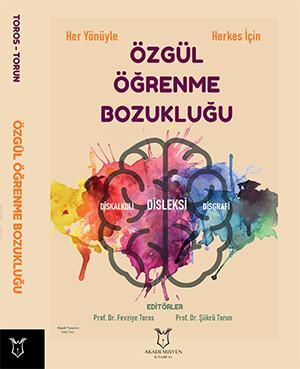
Özgül Öğrenme Bozukluğunun İşaretleri ve Belirtileri
Özet
Psikolog Güneş Turhan tarafından kaleme alınan bu kitap bölümü, yaşam boyu devam eden nörolojik temelli gelişimsel bir bozukluk olan Özgül Öğrenme Bozukluğu’nun (ÖÖB) işaret ve belirtilerini kapsayıcı bir yaklaşımla ele almaktadır. ÖÖB; zekâ düzeyleri normal veya üzerinde olan bireylerin okuma (disleksi), yazma (disgrafi) ve matematik (diskalkuli) gibi temel alanlarda sergiledikleri, potansiyelleri ile başarıları arasındaki beklenmedik tutarsızlıklarla karakterize edilir. Eser, belirtilerin bebeklik, erken çocukluk, okul, ergenlik ve yetişkinlik dönemleri boyunca geçirdiği gelişimsel evreleri; motor koordinasyon, yürütücü işlevler, çalışma belleği ile sosyal ve duygusal beceriler üzerindeki etkileriyle detaylandırmaktadır. Bebeklikteki dil gelişiminde gecikme ve motor güçlüklerden başlayarak, yetişkinlik dönemindeki akademik, mesleki, finansal ve organizasyonel alanlarda yaşanan problemlere kadar geniş bir yelpazeyi değerlendiren çalışma, erken tanı ve uygun öğrenme stillerinin hayati rolüne dikkat çekmektedir. Aileler, eğitmenler ve ruh sağlığı uzmanları için son derece kıymetli bir kaynak niteliği taşıyan bu metin, ÖÖB'li bireylerin yaşadığı güçlükleri en aza indirgeyerek sosyal ve akademik başarılarını desteklemeye yönelik bütüncül bir rehber sunmaktadır.
Referanslar
Visser T. A, Boden C, Giaschi D. E. Children with dyslexia: evidence for visual attention deficits in perception of rapid sequences of objects. Vision Research, 2004; 44(21): 2521-2535.
Aksoy Ş. G. Yaşam boyu özgül öğrenme güçlüğü. İKSSTD 2019;11(Ek sayı):34-39
Aslan K. Özgül öğrenme güçlüğünün erken dönem belirtileri ve erken müdahale uygulamalarına dair derleme. Hacettepe Üniversitesi Sağlık Bilimleri Fakültesi Dergisi 2015; 1(Ek sayı):2.
Amerikan Psikiyatri Birliği, Ruhsal bozuklukların tanısal ve sayımsal el kitabı (DSM-5), Tanı ölçütleri el kitabı. Köroğlu E (Çev.) 2. Baskı Ankara: Hekimler Yayın Birliği. 2013, 34-36
Wagner RK, Zirps FA, Edwards AA, Wood SG, Joyner RE, Becker BJ, Liu G, Beal B. The prevalence of dyslexia: a new approach to its estimation. Journal of Learning Disabilities 2020; 53.5: 354-365.
Elbro C, Nielsen I, Petersen DK. Dyslexia in adults: Evidence for deficits in non-word reading and in the phonological representation of lexical items. Annals of dyslexia, 1994, 44.1: 203-226.
Roitsch J, Watson S. An Overview of Dyslexia: Definition, Characteristics, Assessment, Identification, and Intervention. Science 2019, 7.4: 81-86.
Abd Rauf AA, Ismail MA, Balakrishnan V, Haruna K. Dyslexic children: The need for parents awareness. Journal of Education and Human Development, 2018, 7.2: 91-99.
Chung PJ, Patel DR, Nizami I. Disorder of written expression and dysgraphia: definition, diagnosis, and management. Translational pediatrics, 2020, 9(Suppl 1): S46.
Augur J. Dyslexia. Early Help. Better Future. British Dyslexia Association, 1994.
Sako E. The emotional and social effects of dyslexia. European Journal of Interdisciplinary Studies, 2016, 2.2: 233-241.
Francisco AA, Jesse A, Groen MA, McQueen JM. A general audiovisual temporal processing deficit in adult readers with dyslexia. Journal of speech, language, and hearing research, 2017, 60.1: 144-158.
Thakran S, Learning Disabilities Types and Symptoms. International Journal of Applied Research 2015; 1.5: 149-152
Sanfilippo J, Ness M, Petscher Y, Rappaport L, Zuckerman B, Gaab N. Reintroducing dyslexia: early identification and implications for pediatric practice. Pediatrics, 2020,146.1.
Kalashnikova M, Goswami U, Burnham D. Novel word learning deficits in infants at family risk for dyslexia. Dyslexia, 2020, 26.1: 3-17.
Thiede A, Virtala P, Ala-Kurikka I, Partanen E, Huotilainen M, Mikkola K, Kujala T. An extensive pattern of atypical neural speech-sound discrimination in newborns at risk of dyslexia. Clinical Neurophysiology, 2019, 130.5: 634-646.
Shah HR, Sagar JKV, Somaiya MP, Nagpal JK. Clinical practice guidelines on assessment and management of specific learning disorders. Indian journal of psychiatry, 2019, 61.(Suppl 2): 211.
Doyle A. Dyscalculia and mathematical difficulties: Implications for transition to higher education in the Republic of Ireland. Disability Service Symposium Trinity College Dublin, 2010.
Ozernov‐Palchik O, Gaab N. Tackling the ‘dyslexia paradox’: reading brain and behavior for early markers of developmental dyslexia. Wiley Interdisciplinary Reviews: Cognitive Science, 2016, 7.2: 156-176.
Iuculano T. Neurocognitive accounts of developmental dyscalculia and its remediation. Progress in brain research, 2016, 227: 305-333.
Balikci OS, Melekoglu MA. Early Signs of Specific Learning Disabilities in Early Childhood. International Journal of Early Childhood Special Education, 2020, 12.1: 84-95
Zhagan, M., & Al-Abboud, A. Etiology and epidemics of dyslexic towards intervention and instructional strategy. International Journal Of Creative Research And Studies, 2019, 3.5.
Handler SM, Walter MF. Reading difficulties and the pediatric ophthalmologist. Journal of AAPOS 2017, 436-442.
Apriani E, Supardan D. Language Learning Disabilities: How Can I Help My Students with Dyslexia?. ENGLISH FRANCA: Academic Journal of English Language and Education, 2018, 2.2: 187-200.
National Center Of Learning Disabilities. Early detection of learning difficulties, 2020. https://www.ncld.org/wp-content/uploads/2020/10/Early-Detection-of-Learning-Difficulties-1.pdf . Erişim tarihi: 26 Şubat, 2021.
Gonzalez M, Brown TB. Early Childhood Educators' Perceptions of Dyslexia and Ability to Identify Students At-Risk. Journal of education and learning, 2019, 8.3: 1-12.
California Dyslexia Guidelines, Mclean J. (Ed.) Sacramento: Special Education Division of the California Department of Education (CDE), 2017, 11-71 https://www.cde.ca.gov/sp/se/ac/documents/cadyslexiaguidelines.pdf
Türkoğlu S, Çetin FH, Tanır Y, Karatoprak S. Çalışma belleği ve nörogelişimsel hastalıklar. Çocuk ve Gençlik Ruh Sağlığı Dergisi, 2019, 26.2: 52-62.
Akyürek G. Disleksili Çocuklarda Bilişsel Terapinin Yürütücü İşlevler ve Aktivite Rutinlerine Etkisi. H.Ü. Sağlık Bilimleri Enstitüsü, Doktora Tezi. 2017.
Akyürek G, Bumin G. Disleksili Çocuklarda Ev Okur Yazarlık Ortamı ve Aktivite Rutinleri - Home Literacy Environment and Occupational Routines in Children with Dyslexia. Bozok Tıp Dergisi, 2018, 8.3: 16-23.
Al-Shidhani TA, Arora V. Understanding dyslexia in children through human development theories. Sultan Qaboos University Medical Journal, 2012, 12.3: 286.
Salman U, Özdemir S, Salman AB, Özdemir F. Özel öğrenme güçlüğü “Disleksi”. İstanbul Bilim Üniversitesi Florence Nightingale Tıp Dergisi, 2016, 2.2: 170-176.
Özyürek A, Gürleyik S, Özdemir S, Sancı NG. Çocuklarda sayı, sıvı ve uzunluk korunumu gelişiminin cinsiyet ve yaş değişkeni açısından incelenmesi. Milli Eğitim Dergisi, 46.216: 5-19.
Mahmud MS, Zainal MS, Rosli R, Maat SM. Dyscalculia: What We Must Know about Students' Learning Disability in Mathematics?. Universal Journal of Educational Research, 2020, 8.12B: 8214-8222.
Livingston EM, Siegel LS, Ribary U. Developmental dyslexia: Emotional impact and consequences. Australian Journal of Learning Difficulties, 2018, 23.2: 107-135.
Döhla D, Heim S. Developmental dyslexia and dysgraphia: What can we learn from the one about the other? Frontiers in psychology, 2016, 6: 2045.
Laasonen M, Salomaa J, Cousineau D, Leppämäki S, Tani P, Hokkanen L., Dye M. Project DyAdd: visual attention in adult dyslexia and ADHD. Brain and cognition, 2012, 80.3: 311-327.
Kaufmann L, von Aster M. The diagnosis and management of dyscalculia. Deutsches Ärzteblatt International, 2012, 109.45: 767.
Biotteau M, Danna J, Baudou É, Puyjarinet F, Velay JL, Albaret JM, Chaix Y. Developmental coordination disorder and dysgraphia: signs and symptoms, diagnosis and rehabilitation. Neuropsychiatric disease and treatment, 2019, 15: 1873.
Martins MRI, Bastos JA, Cecato AT, Araujo MDLS, Magro RR, Alaminos V. Screening for motor dysgraphia in public schools. Jornal de Pediatria (Versão em Português), 2013, 89.1: 70-74.
Levinson LM. Neural Correlates of Early-Stage Visual Processing Differences in Developmental Dyslexia. Columbia University. PhD Thesis. 2018
Huang Y, He M, Li A, Lin Y, Zhang X, Wu K. Personality, behavior characteristics, and life quality impact of children with dyslexia. International journal of environmental research and public health, 2020, 17.4: 1415.
Chung P, Patel DR. Dysgraphia. International Journal of Child and Adolescent Health, 2015, 8.1: 27.
İlker Ö, Melekoğlu MA. İlköğretim döneminde özel öğrenme güçlüğü olan öğrencilerin yazma becerilerine ilişkin çalışmaların incelenmesi. Ankara Üniversitesi Eğitim Bilimleri Fakültesi Özel Eğitim Dergisi, 2017, 18.03: 443-469.
Haberstroh S, Schulte-Körne G. The diagnosis and treatment of dyscalculia. Deutsches Ärzteblatt International, 2019, 116.7: 107.
Fu SH, Chin KE. An online survey research regarding awareness of dyscalculia among educators in Sandakan district, Sabah. International Journal of Academic Research in Progressive Education and Development, 2017, 6.2: 1-10.
Price GR, Ansari D. Dyscalculia: Characteristics, causes, and treatments. Numeracy, 2013, 6.1: 1-16.
Khing B. Dyscalculia: Its types, symptoms, causal factors, and remedial programmes. Learning Community: An International Journal of Educational and Social Development, 2016, 7.3: 217.
Dymock S, Nicholson T. Dyslexia Decoded: What it is, what it isn’t and what you can do about it. Auckland: Dunmore Publishing Ltd, 2013.
Heiervang E, Stevenson J, Lund A, Hugdahl K.. Behaviour problems in children with dyslexia. Nordic journal of psychiatry, 2001, 55.4: 251-256.
Snowling MJ. Developmental dyslexia. Current paediatrics, 2001, 11.1: 10-13.
Geisthardt C, Munsch J. Coping with school stress: A comparison of adolescents with and without learning disabilities. Journal of learning disabilities, 1996, 29.3: 287-296.
Asselborn T, Chapatte M, Dillenbourg P. Extending the spectrum of dysgraphia: A data driven strategy to estimate handwriting quality. Scientific reports, 2020, 10.1: 1-11.
Mcdowell M. Specific learning disability. Journal of paediatrics and child health, 2018, 54.10: 1077-1083.
Ontario Psychological Association, Guidelines for Diagnosis and Assessment of Children, Adolescents, and Adults with Learning Disabilities: Consensus Statement and Supporting Documents, Ontario, 2020.
Leather C, Hogh H, Seiss E, Everatt J. Cognitive functioning and work success in adults with dyslexia. Dyslexia, 2011, 17.4: 327-338.
Everatt John. The abilities and disabilities associated with adult developmental dyslexia. Journal of Research in Reading, 1997, 20.1:13-21.
Snowling Margaret J. Early identification and interventions for dyslexia: a contemporary view. Journal of Research in Special Educational Needs, 2013, 13.1: 7-14.
Buchholz J, Davies AA. Adults with dyslexia demonstrate space-based and object-based covert attention deficits: Shifting attention to the periphery and shifting attention between objects in the left visual field. Brain and Cognition, 2005, 57.1: 30-34.
Moreau D, Wiebels K, Wilson AJ, Waldie KE. Volumetric and surface characteristics of gray matter in adult dyslexia and dyscalculia. Neuropsychologia, 2019, 127: 204-210.
Schulte-Körne G. The prevention, diagnosis, and treatment of dyslexia. Deutsches Ärzteblatt International, 2010, 107.41: 718.
Warmington M, Stothard SE, Snowling MJ. Assessing dyslexia in higher education: The York adult assessment battery‐revised. Journal of Research in Special Educational Needs, 2013, 13.1: 48-56.
Shaywitz SE, Holahan JM, Kenney B, Shaywitz BA. The Yale Outcome Study: Outcomes for Graduates with and without Dyslexia. Journal of Pediatric Neuropsychology, 2020, 6.4: 189-197.
Smith-Spark JH, Fisk JE. Working memory functioning in developmental dyslexia. Memory, 2007, 15.1: 34-56.
Snowling M, Dawes P, Nash H, Hulme C. Dyslexia : Validity of a Protocol for Adult Self-Report of Dyslexia and Related Difficulties. Wiley Online Library. 2012, 18: 1–15.