Kas Sistemi (Myoloji)
Synopsis
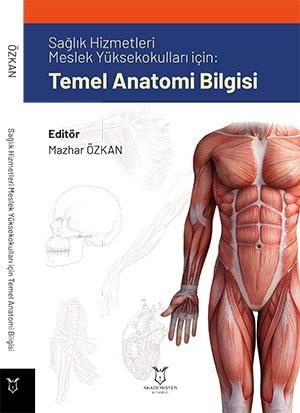
This text comprehensively examines the muscular system (myology), which forms the active part of the locomotor system, and the muscle groups in the human body. Muscles are divided into three types based on their histological and functional properties: smooth muscles working involuntarily, cardiac muscle possessing its own conduction system, and striated skeletal muscles working voluntarily. In muscle anatomy, the non-contractile part attaching to the bone is called the tendon, the origin point is origo, the insertion point is insertio, the muscle belly is venter, and the membrane wrapping the muscle is fascia. The point where the nerve enters the muscle is called the motor point, and the resting state of partial contraction is termed muscle tone (tonus). Skeletal muscles are regionally classified into head, neck, back, chest, abdomen, perineum, upper limb, and lower limb muscles. Muscles of facial expression are innervated by n. facialis, muscles of mastication by n. mandibularis, and the main muscle of inspiration, the diaphragm, is innervated by n. phrenicus. Upper limb muscles are located in the shoulder, arm, forearm, and hand, enabling movement via stimulation from n. musculocutaneus, n. radialis, n. medianus, and n. ulnaris. Lower limb muscles are situated in the thigh, gluteal region, leg, and foot, performing pelvic stabilization and locomotor functions such as walking through n. femoralis, n. obturatorius, n. gluteus, n. tibialis, and n. fibularis nerves.
References
Yıldırım M. (2013). Resimli sistematik anatomi. İstanbul: Nobel Tıp Kitabevleri
Gövsa Gökmen F. (2003). Sistematik anatomi. İzmir: İzmir Güven Kitabevi
Arifoğlu Y. (2019). Her yönüyle anatomi. (2. Baskı). İstanbul: İstanbul Tıp Kitabevleri
Atasever A. (2019). Anatomi. (1. Baskı). İstanbul: İstanbul Tıp Kitabevleri