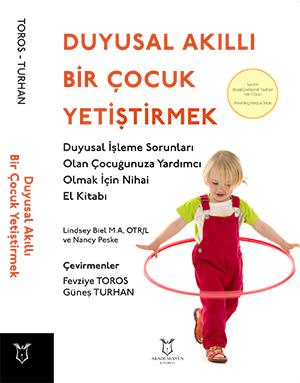
Duyusal Akıllı Bir Çocuk Yetiştirmek
Synopsis
Lindsey Biel ve Nancy Peske tarafından kaleme alınan Duyusal Akıllı Bir Çocuk Yetiştirmek, duyusal işleme sorunları (DİB) yaşayan çocukların ebeveynleri, öğretmenleri ve sağlık profesyonelleri için hazırlanmış rehber niteliğinde son derece kapsamlı ve pratik bir eserdir. Uzman bir ergoterapist ile duyusal zorluklara sahip bir çocuğun annesinin bilgi ve deneyimlerini harmanlayan bu kitap; sekiz duyu sistemini, nöronal ağ yapılanmalarını, duyusal aşırı yüklenmeyi ve sinir sisteminin öz-düzenleme süreçlerini detaylı bir şekilde açıklamaktadır. Eser, duyu bütünleme güçlüklerinin otizm spektrum bozukluğu, DEHB, anksiyete, depresyon, prematüre doğum öyküsü ve gelişimsel gecikmeler gibi eş zamanlı durumlarla olan karmaşık ilişkilerini incelemekte; zorlayıcı davranışların arkasındaki temel duyusal semptomları doğru okumanın ve anlamanın önemini vurgulamaktadır. Dr. Temple Grandin'in ilham verici önsözüyle zenginleşen çalışma; öz bakım, banyo yapma, giyinme, seçici yemek yeme, okul ortamı, doktor ve diş hekimi randevuları ile sosyal etkinliklerde karşılaşılan günlük problemlere yönelik uygulanabilir ve somut çözümler sunmaktadır. Ayrıca nitelikli bir ergoterapist bulma, multidisipliner değerlendirme ekipleriyle çalışma ve çocuğun bedenine ihtiyaç duyduğu uyarımı sağlayacak kişiselleştirilmiş bir "duyusal diyet" hazırlama adımlarını titizlikle aktarmaktadır. Kompresyon giysileri, ağırlıklı battaniyeler, proprioseptif ve vestibüler hareket aktiviteleri gibi duyusal düzenleme araçlarını barındıran bu kılavuz, çocukların kendi duyusal öz-savunuculuklarını geliştirmelerine ve yaşam kalitelerini yükseltmelerine katkı sağlayan eşsiz bir başvuru kaynağıdır.
Written by Lindsey Biel and Nancy Peske, Raising a Sensory Smart Child is an exceptionally comprehensive and practical guide prepared for parents, teachers, and healthcare professionals of children experiencing sensory processing issues (SPD). Blending the expertise of a pediatric occupational therapist with the personal insights of a mother of a child with sensory challenges, the book explains in detail the eight sensory systems, neuronal network configurations, sensory overload, and the body's self-regulation processes. The work examines the complex relationships between sensory integration difficulties and co-occurring conditions such as autism spectrum disorder, ADHD, anxiety, depression, prematurity, and developmental delays, emphasizing the importance of correctly interpreting sensory symptoms behind challenging behaviors. Enriched by an inspiring foreword by Dr. Temple Grandin, it offers concrete, actionable solutions for daily struggles encountered in self-care, bathing, dressing, selective eating, school environments, medical and dental visits, and social gatherings. Furthermore, it provides step-by-step guidance on finding a qualified occupational therapist, working with multidisciplinary assessment teams, and creating a personalized "sensory diet" to supply the body with its required sensory input. Incorporating sensory regulation tools such as compression garments, weighted blankets, and proprioceptive and vestibular movement activities, this handbook serves as an indispensable reference that helps children develop sensory self-advocacy and improve their overall quality of life.
References
Sensory Integration International, duyu bütünleme işlev bozukluğunun/SPD'nin genel nüfusun yüzde 15'ini etkilediğini tahmin ediyor ve Occupational Therapy Journal of Research'te yayınlanan 1997 tarihli bir araştırma, Amerikalı çocukların yüzde 10'unun etkilendiğini buldu.
L. J. Miller, M. E. Anzalone, S. J. Lane, S. A. Cermak, and E. T. Osten, “Concept Evolution in Sensory Integration: A Proposed Nosology for Diagnosis,” American Journal of Occupational Therapy 61 (2007): 135–40.
A. G. Fisher and A. C. Bundy, “Vestibular Stimulation in the Treatment of Postural and Related Disorders,” in Manual of Physical Therapy Tech‑ niques, O. D. Payton, R. P. DiFabio, S. V. Paris, E. J. Protas, and A. F. VanSant, eds. (New York: Churchill Livingstone, 1989), pp. 239–58.
Sheila M. Frick and Colleen H. Hacker, Listening with the Whole Body (Madison, WI: Vital Links, 2000), pp. 3:27–39.
W. J. Gavin, A. Dotseth, K. K. Roush, C. A. Smith, H. D. Spain, and
P. L. Davies, “Electroencephalography in Children with and without Sensory Processing Disorders during Auditory Perception,” Ameri‑ can Journal of Occupational Therapy 65, no. 4 (2011): 370–77. İşitsel eşiklerle ilgili yapılmış olan bu EEG çalışması, daha önce duyusal işlemleme bozukluğu teşhisi konan çocukları, tonları ve değişen frekans ve yoğunluktaki sesleri dinlerken tipik olarak gelişen akranlarıyla karşılaştırdı. Araştırmacılar, DİB'li çocuklar ile nörotipik akranlarını yüzde 79 doğrulukla ayırt edebildiler.
T. C. Ray, L. J. King, and T. Grandin, “The Effectiveness of Self‑ Initiated Vestibular Stimulation in Producing Speech Sounds in an Autistic Child,” Occupational Therapy Journal of Research 8, no. 3 (1988): 187–91; and H. Schueli, V. Henn, and P. Brugger, “Vestibular Stimulation Affects Dichotic Lexical Decision Performance,” Neu‑ ropsychologia 37, no. 6 (1999): 653–59.
J. H. Foss‑Feig, D. Tadin, K. B. Schauder, and C. J. Cascio, “A Substan‑ tial and Unexpected Enhancement of Motion Perception in Autism,” Journal of Neuroscience 33, no. 19 (2013): 8243–49.
Helen Irlen, Reading by the Colors: Overcoming Dyslexia and Other Reading Disabilities through the Irlen Method (New York: Perigee, 1991); and Stephen M. Edelson, “Scotopic Sensitivity Syndrome and the Irlen Lens System,” Autism Research Institute, https://www.autism.com /understanding_irlens.
J. A. Veitch and S. L. McColl, “Modulation of Fluorescent Light: Flick‑ er Rate and Light Source Effects on Visual Performance and Visual Comfort,” Lighting Research and Technology 27 (1995): 243–56.
STAR Institute for Sensory Processing Disorder, “Your Eight Senses,” https://www.spdstar.org/basic/your-8-senses#f8.
John J. Ratey, A User’s Guide to the Brain (New York: Vintage Books, 2001), p. 24.
J. Piven, J. T. Elison, and M. J. Zylka, “Toward a Conceptual Frame‑ work for Early Brain and Behavior Development in Autism,” Molecu‑ lar Psychiatry 22, no. 10 (2017), 1385–94.
G. D. Reeves, “From Neuron to Behavior: Regulation, Arousal, and Attention as Important Substrates for the Process of Sensory Integra‑ tion,” in Understanding the Nature of Sensory Integration with Diverse Populations, S. Smith‑Roley, E. Imperatore‑Blanche, and R. C. Schaaf, eds. (San Antonio, TX: Therapy Skill Builders, 2001), pp. 89–108.
T. Grandin, “Calming Effects of Deep Touch Pressure in Patients with Autistic Disorder, College Students, and Animals,” Journal of Child and Adolescent Psychopharmacology 2, no. 1 (1992): 63–72.
B. Bursch, K. Ingman, L. Vitti, P. Hyman, and L. K. Zeltzer, “Chronic Pain in Individuals with Previously Undiagnosed Autistic Spectrum Disorders,” The Journal of Pain 5, no. 5 (2004): 290–95.
D. N. McIntosh, L. J. Miller, V. Shya, and R. J. Hagerman, “Sensory‑ Modulation Disruption, Electrodermal Responses, and Functional Behaviors,” Developmental Medical and Child Neurology 41 (1999): 608–15; R. C. Schaaf, L. J. Miller, D. Seawell, and S. O’Keefe, “Chil‑ dren with Disturbances in Sensory Processing: A Pilot Study Exam‑ ining the Role of the Parasympathetic Nervous System,” American Journal of Occupational Therapy 57, no. 4 (2003): 442–49; S. A. Sch‑ oen, L. J. Miller, B. Brett‑Green, and S. L. Hepburn, “Psychophysiol‑ ogy of Children with Autism Spectrum Disorder,” Research in Autism Spectrum Disorders 2, no. 3 (2007): 417–29; and S. Schoen, L. Miller, B. Brett‑Green, and D. Nielsen, “Physiological and Behavioral Differ‑ ences in Sensory Processing: A Comparison of Children with Autism Spectrum Disorder and Sensory Modulation Disorder,” Frontiers in Integrative Neuroscience 3, no. 29 (2009): 1–11.
Y. Chang, M. Gratiot, J. Owen, A. Brandes‑Aitken, S. S. Desai, S. S.
Hill, A. B. Arnett, J. Harris, E. J. Marco, and P. Mukherjee, “White Matter Microstructure Is Associated with Auditory and Tactile Pro‑ cessing in Children with and without Sensory Processing Disorder,” Frontiers in Neuroanatomy 9 (2016): 169; and J. P. Owen, E. J. Marco,
S. Desai, E. Fourie, J. Harris, S. S. Hill, A. B. Arnett, and P. Mukherjee, “Abnormal White Matter Microstructure in Children with Sensory Processing Disorders,” Neuroimage. Clinical 2 (2013): 844–53.
Maureen Kessenich, “Developmental Outcomes of Premature, Low Birth Weight, and Medically Fragile Infants,” Newborn and Infant Nursing Reviews 3, no. 3 (2003): 80–87.
R. S. Federici, “Raising the Post‑Institutionalized Child: Risks, Chal‑ lenges and Innovative Treatment,” Ronald S. Federici, PsyD, and Asso‑ ciates with Care for Children International, 1997, http://drfederici.com/raising-the-post-institutionalized-child-risks-challenges-and-innovative-treatment/.
S. L. Judge, “Eastern European Adoptions: Current Status and Impli‑ cations for Intervention,” Topics in Early Childhood Special Education 19, no. 4 (1999): 244–52.
L. Biel, “Sensory Processing Challenges,” in Optimizing Learning Out‑ comes: Proven Brain‑Centric, Trauma‑Sensitive Practices, William Steele, ed. (New York: Routledge, 2017), pp. 74–94.
CDC'ye göre bir FDA incelemesi, yakın zamana kadar aşı koruyucu olarak timerosal kullanımının, yaşamın ilk altı ayında Environmental Protection Agency (Çevre Koruma Ajansı-EPA) yönergelerini aşan cıva alımına neden olmuş olabileceğini bildirmiştir; ancak FDA, Zehirli Maddeler ve Hastalık Kayıt Dairesi veya Dünya Sağlık Örgütü'nünkileri değil. The National Institutes of Health (Ulusal Sağlık Enstitüleri), ABD okullarında özel eğitim gören çocukların sayısının 1990'larda çarpıcı bir sıçrama yaptığını ve bunların, çocuk doktorları standart aşı programını izlemiş olsaydı, EPA standartlarına göre fazla cıva alacak olan çocuklar olduğunu söylüyor.
Stanley Turecki, “The Behavioral Complaint: Symptom of a Psychiat‑ ric Disorder or a Matter of Temperament?” Contemporary Pediatrics 20, no. 8 (2003): 111–19.
Larry B. Silver, The Misunderstood Child, 3rd ed. (New York: Three Rivers Press, 1998), p. 77.
Judith L. Rapoport and Deborah R. Ismond, DSM‑IV Training Guide for Diagnosis of Childhood Disorders (New York: Brunner‑Routledge, 1996), p. 148.
M. Kuhne, R. Schachar, and R. Tannock, “Impact of Comorbid Oppositional or Conduct Problems on Attention‑Deficit Hyperactiv‑ ity Disorder,” Journal of the American Academy of Child & Adolescent Psychiatry 36, no. 12 (1997): 1715–25.
Charles Popper, “Diagnosing Bipolar vs. ADHD: A Pharmacological Point of View,” The Link 13 (1996), http://www.bipolarchildsupport.com/popperarticle.html.
1. C. G. Jung, The Development of Personality: Papers on Child Psy‑ chology, Education, and Related Subjects (Princeton, NJ: Princeton University Press, 1954), p. 140.
Temple Grandin, Thinking in Pictures: And Other Reports from My Life with Autism (New York: Vintage Books, 1995), p. 62.
S. M. Edelson, M. G. Edelson, D. C. R. Kerr, and T. Grandin. “Behavioral and Physiological Effects of Deep Pressure on Children with Au‑ tism: A Pilot Study Evaluating the Efficacy of Grandin’s Hug Machine,” American Journal of Occupational Therapy 53 (1999): 145–52. Çalışma, fizyolojik uyarılma, kaygı, gerginlik ve huzursuzluk- hiperaktiviteyi ölçtü ve derin basıncın, altı hafta süresince haftada iki kez yirmi dakika boyunca derin basınç uygulanan otistik çocuklar için gerilimde önemli bir azalma ve kaygıda hafif bir azalma ile davranışsal ve fizyolojik sakinleştirici bir etkiye sahip olduğunu buldu. Çalışma, derin basının daha yüksek düzeyde kaygı veya uyarılma olan çocuklar için en iyi sonucu verdiğini buldu. Ayrıca T. Grandin, “Calming Effects of Deep Touch Pressure in Patients with Autistic Disorder, College Students, and Animals,” Journal of Child and Adolescent Psychopharmacology 2, no. 1 (1992): 63–70 yayınına bakınız.
L. Marlier, C. Gaugler, and J. Messer, “Airway Obstruction in Prema‑ ture Newborns: A Missing Link,” Pediatrics 115, no. 1 (2005): 83–88. Bir Fransız yenidoğan yoğun bakım ünitesindeki prematüre bebekler üzerinde yapılan çalışma, yirmi dört ile yirmi sekiz hafta arasında doğan on dört bebeğin kuvözlerine vanilin pompalanmasının apne (uyku apnesi bozuklukları) olaylarının sıklığını azalttığını ve özellikle uyku sırasında solunum hızının etkili bir şekilde arttığını buldu.
Lindsey Biel, Sensory Processing Challenges: Effective Clinical Work with Kids & Teens (New York: W. W. Norton, 2014), pp. 100–108; D. L. Schil‑ ling, K. Washington, F. F. Billingsley, and J. Deitz, “Classroom Seating for Children with Attention Deficit Hyperactivity Disorder: Therapy Balls Versus Chairs,” American Journal of Occupational Therapy 57 (2003): 534–57; S. Stevens, and J. Gruzelier, “Electrodermal Activity to Auditory Stimuli in Autistic, Retarded, and Normal Children,” Journal of Autism and Developmental Disorders 14, no. 3 (1984): 245–60; N. L. Vandenberg, “The Use of a Weighted Vest to Increase On Task Behavior in Children with Attention Difficulties,” American Journal of Occupa‑ tional Therapy 55, no. 6 (2001): 621–28; D. Walker and K. McCormack, The Weighted Blanket: An Essential Nutrient in a Sensory Diet (Everett, MA: Village Therapy, 2002); and Patricia Wilbarger and Julia Wilbarg‑ er, “The Wilbarger Approach to Treating Sensory Defensiveness,” in Sensory Integration: Theory and Practice, 2nd ed., A. C. Bundy, S. J. Lane, and E. A. Murray, eds. (Philadelphia: Davis, 2002), p. 335.
Norman Doidge, The Brain That Changes Itself (New York: Penguin, 2007).
Molly Harmon, Meghan Fisher, and Brent McBride, “Under‑Referrals for Developmental Delays by Pediatricians: A Systematic Review,”poster presented at the University of Illinois at Urbana‑Champaign Undergraduate Research Symposium, May 2015, http://hdl.handle.net/2142/77735.
Ross W. Greene, The Explosive Child: A New Approach for Under‑ standing and Parenting Easily Frustrated, Chronically Inflexible Chil‑ dren (New York: HarperCollins, 2014), p. 10.
N. Walker and M. Whelan, “Surveyed Autistic Children and Adults Reported Hypersensitivity to Touch (80 Percent) and Sound (87 Per‑ cent), Problems with Vision (86 Percent), and Sensitivity to Taste or Smell (30 Percent),” paper presented at the Geneva Symposium on Autism, October 27, 1994, Toronto; and S. I. Greenspan and S. Wieder, “Developmental Patterns and Outcomes in Infants and Children with Disorders in Relating and Communicating: A Chart Review of 200 Cases of Children with Autism Spectrum Diagnoses,” Journal of De‑ velopmental and Learning Disorders 1 (1997): 87–142.
S. A. Schoen, L. J. Miller, B. Brett‑Green, and S. L. Hepburn, “Psycho‑ physiology of Children with Autism Spectrum Disorder,” Research in Autism Spectrum Disorders 2, no. 3 (2008): 417–29. Yüksek işlevli otizmi ve asperger sendromu olan çocuklarda uyarılma düzeylerini ve duyusal reaktiviteyi ölçen elektrodermal aktivite çalışmaları, yavaş alışmayla birlikte yüksek uyarılma (aşırı tepkililik) ve daha hızlı alışmayla birlikte düşük uyarılma (düşük tepki verme) arasında belirgin kalıplar göstermiştir. Ayrıca bkz: S. A. Schoen, L. J. Miller, B. Brett‑Green, and D. M. Nielson, “Physiological and Behavioral Difference in Sensory Processing: A Comparison of Children with Autism Spectrum Disor‑ der and Sensory Modulation Disorder,” Integrative Neuroscience 3 (2009), doi.org/10.3389/neuro.07.029.2009.
A. Ben‑Sasson, L. Hen, R. Fluss, S. A. Cermak, B. Engel‑Yeger, and
E. Gal, “A Meta‑Analysis of Sensory Modulation Symptoms in Individuals with Autism Spectrum Disorders,” Journal of Autism and Developmental Disorders 39, no. 1 (2009): 1–11.
A. Zurcher, “‘Presume Competence’—What Does That Mean Exact‑ ly?,” Emma’s Hope Book, March 7, 2013, https://emmashopebook.com/2013/03/07/presume-competence-what-does-that-mean-exactly.
Temple Grandin, On Visual Thinking, Sensory, Careers and Medica‑ tions, DVD (Arlington, TX: Future Horizons, 2003).
Thomas A. McKean, Soon Will Come the Light (Arlington, TX: Future Horizons, 2001), p. 63.
Luke Jackson, Freaks, Geeks & Asperger Syndrome: A User Guide to Adolescence (London: Jessica Kingsley, 2002), p. 71.
J. H. Foss‑Feig, D. Tadin, K. B. Schauder, and C. J. Cascio, “A Substan‑ tial and Unexpected Enhancement of Motion Perception in Autism,” Journal of Neuroscience 33, no. 19 (2013): 8243–49.
Donna Williams, Somebody Somewhere: Breaking Free from the World of Autism (New York: Three Rivers Press, 1994), p. 96.
Patricia M. Hamaguchi, Childhood Speech, Language, and Listening Problems: What Every Parent Should Know (New York: Wiley, 2001), p. 171.
Melanie Potock, personal communication, September 19, 2017.
Laurence D. Martell, Light: An Element in the Ergonomics of Learning, National Academy of Integrative Learning, n.d., www.euro-lighting- gmbh.de/ upload/ 15757770 - Light An- Element-in- the- Ergonomics-of-Learning-by-Laurence-D.-Martel-Ph.D.-07.2017.pdf; and Jacob Liberman, Light: Medicine of the Future (Santa Fe, NM: Bear, 1992).
Larry B. Silver, The Misunderstood Child (New York: Three Rivers Press, 1998), p. 17.
E. Carte, D. Morrison, J. Sublett, A. Uemura, and W. Setrakian, “Sensory Integration Therapy: A Trial of a Specific Neurodevelopmental Therapy for the Remediation of Learning Disabilities,” Developmental and Behavioral Pediatrics 5 (1984): 189–94.
Temple Grandin, “My Experiences with Visual Thinking, Sensory Problems, and Communication Difficulties,” Center for the Study of Autism, June 2000, www.scribd.com/document/36780160/My-Experi ences-With-Visual-Thinking-Sensory- Problems-and- Communication-Difficulties.
B. Jacqueline Stordy and Malcolm J. Nicholl, The LCP Solution (New York: Ballantine Books, 2000).
Sharon A. Gutman and Lindsey Biel, “Promoting the Neurological Substrates of Well‑Being through Occupation,” Occupational Therapy in Mental Health 17, no. 1 (2001): 1–22.
M. Scheiman, P. Blaskey, M. Gallaway, E. Ciner, and M. Parisi, “Vi‑ sion Characteristics of Adult Irlen Filter Candidates: Case Studies,” Journal of Behavioral Optometry 1, no. 7 (1990): 174–78.
B. K. Hölzel, J. Carmody, M. Vangel, C. Congleton, S. M. Yerramsetti,
T. Gard, and S. W. Lazar, “Mindfulness Practice Leads to Increases in Regional Brain Gray Matter Density,” Psychiatry Research: Neuroim‑ aging 191, no. 1 (2011): 36–43.
John Elder Robison, Switched On: A Memoir of Brain Change and Emotional Awakening (New York: Spiegel & Grau, 2016), p. 23.
A. P. Allen and A. P. Smith, “A Review of the Evidence That Chewing Gum Affects Stress, Alertness and Cognition,” Journal of Behavioral and Neuroscience Research 9, no. 1 (2011): 7–23.
S. Franceschini, S. Gori, M. Ruffino, S. Viola, M. Molteni, and A. Facoet‑ ti, “Action Video Games Make Dyslexic Children Learn Better,” Cur‑ rent Biology 23, no. 6 (2013): 462–66. www.cell.com/current-biology/fulltext/S0960-9822(13)00079-1.
J. A. Anguera, A. N. Brandes‑Aitken, A.D . Antovich, C. E. Rolle, S. S. Desai, and E. J. Marco, “A Pilot Study to Determine the Feasibility of Enhancing Cognitive Abilities in Children with Sensory Processing Dysfunction,” PLoS ONE 12, no. 4 (2017): 0172616, http://journals.plos. org/plosone/article?id=10.1371/journal.pone.0172616.
J. Melke, H. Gubron Botros, P. Chaste, et al., “Abnormal Melatonin Synthesis in Autism Spectrum Disorders,” Molecular Psychiatry 13, no. 1 (2008): 90–98, www.ncbi.nlm.nih.gov/pubmed/17505466.
University of Missouri–Columbia, “Children and Teens with Autism More Likely to Become Preoccupied with Video Games,” Science‑ Daily, April 17, 2013, www.sciencedaily.com/releases/2013/04/13041 7130747.htm.
Published
License
LicenseBu İnternet Sitesi içeriğinde yer alan tüm eserler (yazı, resim, görüntü, fotoğraf, video, müzik vb.) Akademisyen Kitabevine ait olup, 5846 sayılı Fikir ve Sanat Eserleri Kanunu ve 5237 sayılı Türk Ceca Kanunu kapsamında korunmaktadır. Bu hakları ihlal eden kişiler, 5846 sayılı Fikir ve Sanat eserleri Kanunu ve 5237 sayılı Türk Ceza Kanununda yer alan hukuki ve cezai yaptırımlara tabi olurlar. Yayınevi ilgili yasal yollara başvurma hakkına sahiptir.
