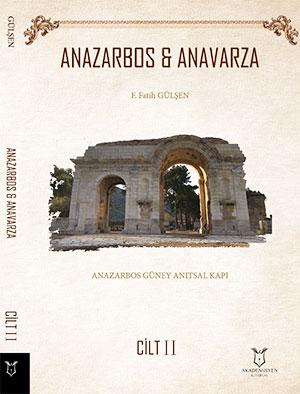
ANAZARBOS IN BYZANTINE PERIOD
Synopsis
Anazarbos (Anavarza) is a strategic ancient city located at the junction of today's Kadirli, Kozan, and Ceyhan districts, which came under the rule of various nations throughout history. Holding the title of Metropolis since AD 204/205, the city became the capital of the province of Cilicia Secunda in AD 408 following the division of the Cilicia Region during the reign of Emperor Theodosius II. The martyrdom of three saints in the city's amphitheater in AD 304 made Anazarbos an important Christian center, and its metropolitans actively attended religious councils in the 5th and 6th centuries. Economic growth in Late Antiquity accelerated church construction, and the city was rebuilt following major earthquakes in 525 and 561. The Byzantine-era structures in the city, which also remained under Persian, Arab (Ayn Zarba), and Armenian Kingdom rule, have been researched by scholars since 1905. Investigations reveal that the Apostles Church, built over a Pagan temple and considered the city's cathedral, the cross-plan Southwestern Church thought to be dedicated to the three saints, the Rock-Cut Church distinguished by its AD 516 inscription and narthex, and the St. Menas Martyrion identified through geophysical methods constitute the main examples of religious architecture. In terms of civil architecture, aqueducts dated to prior to the 6th-century AD earthquake based on brickwork technique are present. All evaluated Byzantine structures are generally dated between the beginning of the 5th century AD and the first half of the 6th century AD.
References
Bayliss 2001 Bayliss, R., Provincal Cilicia and the Archaeology of Temple Conversion, Submitted for the Degree of Doctor of Philosophy University of Newcastle upon TyneDepartment of Archaeology.
Bayliss 2004 Bayliss, R., Provincial Cilicia and the Archaeology of Temple Conversion BAR S1281
Bell 1906 Bell, G. L. “Notes On A Journey Through Cılıcıa And Lycaonıa” RArch VII, 1-29.
Demirci 2016 Demirci, M., “Abbasiler Döneminde Adana ve Çukurova’nın İskanı ve İslamlaştırılması” Tarihte Adana ve Çukurova c. 1,309-324.
Engelmann – Niewöhner 2010 Engelmann, I.– Niewöhner, P., “Bauen nach der Krise.
Die Spoliengalerie an der Apsis der Apostelkirche von Anazarbos” Krise und Kult. Vorderer Orient und Nordafrika von Aurelian bis Iustinian
Gough 1952 Gough, M.R.E.,"Anazarbus". Anatolian Studies 2, 85-150.
Gough, 1955 Gough M.R.E.,"Early churches in Cilicia". Byzantinoslavica 16(2), 201-211.
Halaçoğlu 1979 Hallaçoğlu, Y., “Tapu- Tahrir Defterlerine Göre XVI. Yüzyılın İlk Yarısında Sis(Kozan) Sancağı”, TD XXXXII, 830-832.
Hançer 2016 Hançer, E., “Kilikya Ermeni Prensliği’nin İkinci Başkenti Anavarza” OLBA XIX, 283-314.
Hill 1996 Hill, St., The Early Byzantine Churches of Cilicia and Isauria (Birmingham Byzantine and Ottoman Monographs, 1), Aldershot, Hampshire & Brookfield, Vermont.
Hild – Hellenkemper & Hellenkemper-Salies 1984-1989 Hild. F. –Hellenkemper,
H.&Hellenkemper-Salies, G.,“Kommagene — Kilikien — Isaurien,” RBK 4, 182-356.
Hellenkemper – Hild 1986 Hellenkemper, H. – Hild, F., Neue Forschungen in Kilikien, (Veröffentlichungen der Kommission für die Tabula Imperii Byzantini, Bd. 4) Viyana.
Hild – Hellenkemper 1990. Hild, F. – Hellenkemper, H., Kilikien und Isaurien (Tabula Imperii Byzantini 5). Wien.
Kırkıl 2016 Kırkıl, E., “İslam coğrafyacılarına göre Sugur-Avasım Bölgesi ve Çukurova'da Türkler” 1. Uluslararası Tarihte Adana ve Çukurova Sempozyumu, 17-19 Nisan 2015, 353-360, Adana.
Koch 2007 Koch, G., Erken hıristiyan sanatı : giriş ; Türkiye'deki erken hıristiyanlık dönemi önemli merkezleri ile birlikte, İstanbul.
Koch 2015 Koch, G., Türkiye'deki Geç Antik Dönem Önemli Merkezleri İle Birlikte Erken Hırıstiyan Sanatı, İstanbul.
Langlois 1861. Langlois, Cf. V., Voyage dans la Cilicie et dans les montagnes du Taurus, Paris.
Mayer & Allen 2012 Mayer, W.&Allen, P., The churches of Syrian Antioch (300 – 638 CE). Leuven ; Paris ; Walpole, MA: Peeters.
Mietke 1999 Mietke, G., “Die Apostelkirche von Anazarbos und Syrien”, Olba 2, 227-239.
Mietke 2009 Mitke, G., “Monumentalisierung christlicher Heiliger in Kilikien in frühbyzantinischer Zeit (Erken Hıristiyanlık Dönemi’nde Kilikia’da Kutsal Kişilere Gösterilen Saygı), OLBA VII, 117-140.
Ostrogorsky 2011 Ostrogorsky, G., Bizans Devleti Tarihi, Ankara.
Posamentir – Sayar 2006 Posamentir, R., – Sayar, H. “Anazarbos – ein Zwischenbericht aus der Metropole des Ebenen Kilikien” İstmitt 56,317-357.
Posementir 2011 Posamentir, R., “Anazarbos in Late Antiquity”, in: Archaeology and the cities of Asia Minor in late antiquity, 2011, 205-224.
Ramsay – Bell 1909 Ramsey, W. M. – Bell, G. L. The Thousand and One Churches. London: Hodder and Stoughton.
Tiefenbach 2012 Tiefenbach, H., Anadolu’nun Azizleri, İstanbul.
The chronicle of Theophanes: "Anni mundi" 6095-6305 (A.D. 602-813) trans. Harry Turtledove (Philadelphia: University of Pennsylvania Press, 1982).
Ünal – Girginer 2007 Ünal, A., Girginer, S., Kilikya- Çukurova İlk Çağlardan Osmanlılar Dönemine kadar Kilikya’da Tarihi Coğrafya, Tarih ve Arkeoloji, Adana.