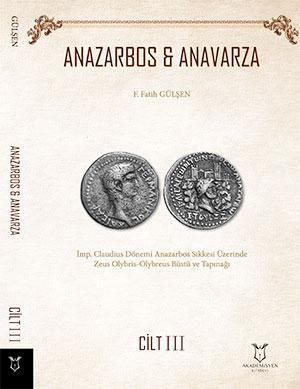
REFLECTIONS ON HISTORY OF ANAZARBOS CITY IN LIGHT OF A COIN FIND
Synopsis
This study examines the history and strategic position of Anazarbos, an important city in Eastern Plain Cilicia, in light of a rare Roman Imperial coin discovered in the Sakaltutan location of Osmaniye. Minting its first Roman Imperial coin under the name "Caesarea" in 20 BC under King Tarcondimotos II, the city developed over time, competed with Tarsos, and earned the titles of neokoros and metropolis. It served as a critical military base due to its logistical support provided to Roman legions on the Eastern Front during the Parthian wars and its position along key transport routes. Found in an ancient mill on Akyol during the 2017 field surveys, the bronze triassarion coin dated to 219/220 AD was minted in honor of Augusta Julia Paula, wife of Emperor Elagabalus. Depicting the Moon Goddess Selene moving from left to right on a chariot drawn by two oxen on its reverse, this piece is unique compared to other known Julia Paula specimens due to its reversed direction of motion. Inscriptions such as AMK and T B on the coin emphasize that the city earned the neokoros title twice and highlight its metropolis status. Although little is known about the pre-Roman period of Anazarbos, 5th-century BC coins, obsidian workshop traces near the acropolis, and Hellenistic ceramic finds demonstrate that the city was a thriving cultural and commercial center prior to Roman rule.
References
Comnena, Anna. Alexiada. The Alexiad of Anna Comnena. Çev. E.R.A. Sewter. 1969. Penguin Classics. Londra.
Dio Cassius Roman History. Cilt IX. Çev. Earnest Cary. Loeb Classical Library, Harvard University Press. 1927.
Malalas Malalas, Johannes., Chronographia. Çev. E. Chilmead. Corpus scriptorum historiae byzantinae. Bonnae. Impensis ed. Weberi. 1831.
Prokopios The Secret History. (Çev.) Henry Bronson Dewing. Loeb Classical Library, Harvard University Press. 1935.
Alkım 1959 Alkım, U. Bahadır., “Güney-batı Antitoros Bölgesinde Eski Bir Yol Şebekesi”, Belleten 23, 59- 77.
Bossert ve Alkım 1947 Bossert, H. Th. ve U. Bahadır Alkım., Karatepe. Kadirli ve Dolayları. İkinci Ön Rapor. İ.Ü. Edebiyat Fakültesi Yayınları. İstanbul.
Burrell 2004 Neokoroi Greek Cities and the Roman Emperors, Brill. Leiden.
Çambel ved 2007 Çambel, H., Günay, R., Toydemir Sabuncu, A., Kumkale Toros Eteklerinde Bir Haçlı Kalesi, Ege Yayınları. İstanbul.
De Giorgi 2011 De Giorgi, Andreae. U., “Hellenistic Founders, Roman Builders: Anazarbos in Cilicia”, Hoffmann, A., Posamentir, R., Sayar, M.H., (derl.) Hellenismus in der Cilicia Pedias. BYZAS 12, 121- 138.
Gough, 1952 Gough, M., “Anazarbus”, Anatolian Studies 2, 85-160.
Haymann 2007 Haymann, F., “Hadrian und Aigeai: Ein Neues Tridrachmon”, Gephyra 4, 47 – 57.
Hill 1900 Hill, G., A Catalog of the Greek Coins in the British Museum, Greek Coins of Lycaonia, Isauria, and Cilicia. Londra.
Lichtenberger 2019 Lichtenberger, A., Raja, R., “The Chora of Gerasa/Jerash”, Judaea/Palaestina and Arabia : Cities and Hinterlands in Roman and Byzantine Times. (derl.) Lichtenberger,A., Tal, O., Weiss, Z.,.Cilt.8.4: 115-130. Proylaeum. Heidelberg.
Kaya 2008 Kaya, M.A., Roma’nın Afrikalı İmparatoru Septimius Severus. Arkeoloji ve Sanat Yayınları. İstanbul.
Levy 1998 Levy, B., “Hadrian in Plain Cilicia”, The Princeton University Library Chronicle 59, 3. 640 – 648.
Mitchell 1995 Mitchell, S., Anatolia. Land, Men, and Gods in Asia Minor. I. The Celts and the Impact of the Roman Rule. Oxford University Press. Oxford.
Posamentir 2011 Posamentir, R., “Anazarbos in Hellenismus”, Hoffmann, A., Posamentir, R., Sayar, M.H., (derl.) Hellenismus in der Cilicia Pedias. BYZAS. 12: 97- 120.
Posamentir 2008 Posamentir, R., “Kulturkontakt Als Impuls Architektonischer Innovation: Austauch Und Inspiration in Anazarbos, Einer Vergessenen Grenzstadt Zwischen Ost Und West”, Austausch und Inspiration: Kulturkontakt als Impuls Architektonischer Innovation. Philipp Von Zabern. Mainz. 89- 106.
Posamentir - Sayar 2006 Posamentir, R., Sayar, M.H., “Anazarbos- Ein Zwischenbericht aus der Metropole des Ebenen Kilikien”, Istanbuler Mitteilungen 56, 317- 357.
Russell 1991 Russell, J., “Cilicia- Nutrix Virorum: Cilicians abroad in Peace and War during Hellenistic and Roman Times. Anatolia Antiqua 1, 283 – 297.
Sayar 2013 Sayar, M.H., “Historical geography, ancient cities and harbours in Cilicia Tracheia and in Cilicia Pedias”, L'Anatolie des peuples, des cités et des cultures(IIe millénaire av. J.-C. – Ve siècle ap. J.-C.), 175- 181.
Sayar 1991 Sayar, M.H., “Equites Singulares Augusti in neuen Inschriften aus Anazarbos, Epigraphica”, Anatolica 17, 19 – 40.
Speidel 1994 Speidel,M.P., Riding for Caesar. The Roman Emperors’ Horseguard. Londra.
Tülek 2017 Tülek, F., “Kilise Merkezli Bir Tarımsal Üretim Yerleşimi: Sazaklı”, Rural settlements and Urban centers in Mediterranean During Antiquity. Derl. Ü. Aydınoğlu. A. Mörtel. Mersin Üniversitesi Yayınları. Mersin. 142- 151.
Tülek 2012a Tülek, F., “Osmaniye Arkeolojik Varlıklar Envanteri 2010 - 2013 Yılları Çalışmaları”, Türkiye Bilimler Akademisi Kültür Envanteri Dergisi 10, 31- 59.
Tülek 2012b Tülek, F., “Footsteps of the Arab- Byzantine Armies in Osmaniye Province Cilicia. Proceedings of the 7th International Congress on the Archaeology of the Ancient Near East (ICAANE), London. Cilt 1: 149- 161.
Ziegler 1993 Ziegler, R., Kaiser, Heer und Stadtisches Geld. Untersuchungen zur Münzpraegung von Anazarbos und Anderer Ostkilikischer Stadte. Ergaenzungsbaende zu den Tituli Asiae Minoris. Nr. 16. Österreichische Akademie der Wissenschaften Philosophisch Hirorische Klasse Denkschriften. Band 234. Viyana.