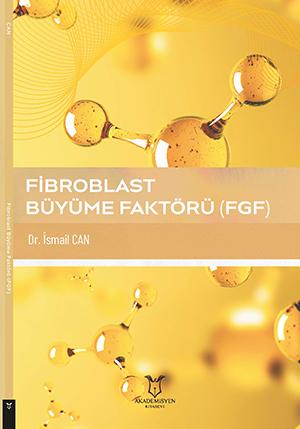
Fibroblast Büyüme Faktörü (FGF)
Özet
Dr. İsmail CAN tarafından kaleme alınan ve Akademisyen Kitabevi tarafından yayımlanan Fibroblast Büyüme Faktörü (FGF) başlıklı bu eser, hücresel sinyal iletimi, doku onarımı, embriyonik gelişim ve metabolik homeostaz süreçlerinde son derece kritik rollere sahip olan büyüme faktörlerini kapsamlı bir biçimde incelemektedir. Toplam üç ana bölümden meydana gelen kitapta; öncelikle memeli FGF ailesinin 23 üyesi, moleküler isimlendirme esasları, tarihsel gelişimi, etki mekanizmalarına göre gruplandırılması (parakrin, endokrin ve hücre içi FGF'ler) ile her bir üyenin doku bazlı spesifik işlevleri ayrıntılarıyla detaylandırılmaktadır. İkinci bölümde, intrinsik tirozin kinaz aktivitesi gösteren FGF reseptörlerinin (FGFR1-4 ve FGFRL1) moleküler yapısı, ligand bağlanma özgüllüğünü belirleyen dokuya özel izoform varyantları (IIIb ve IIIc), Heparan Sülfat Proteoglikanları ile Klotho ailesi proteinlerinin kofaktör rolleri ve RAS-MAPK, PI3K-AKT, PLCγ ile STAT sinyal iletim kaskadları derinlemesine açıklanmaktadır. Üçüncü bölümde ise FGF sinyallerinin gastrulasyon, nörulasyon, organogenez, damarlanma (anjiyogenez), hücresel çoğalma, farklılaşma, kök hücre düzenlenmesi ve doku yenilenmesi üzerindeki biyolojik fonksiyonları bilimsel bir titizlikle sunulmaktadır. Lisanslı tıbbi çalışanlar, akademisyenler ve tıp araştırmacıları için temel bir başvuru kaynağı niteliğinde olan bu nitelikli çalışma, kitap tanıtım platformlarında öne çıkacak yetkinliktedir.
Authored by Dr. İsmail CAN and published by Akademisyen Kitabevi, Fibroblast Growth Factor (FGF) comprehensively examines growth factors that play crucial roles in cellular signal transduction, tissue repair, embryonic development, and metabolic homeostasis. Comprising three main chapters, the book first details the 23 members of the mammalian FGF family, molecular nomenclature principles, historical background, classification based on mechanisms of action (paracrine, endocrine, and intracellular FGFs), and the specific tissue-based functions of each member. The second chapter thoroughly explains the molecular structure of FGF receptors (FGFR1-4 and FGFRL1) possessing intrinsic tyrosine kinase activity, tissue-specific isoform variants (IIIb and IIIc) determining ligand-binding specificity, the cofactor roles of Heparan Sulfate Proteoglycans and Klotho family proteins, as well as signal transduction cascades such as RAS-MAPK, PI3K-AKT, PLCγ, and STAT. The third chapter presents the biological functions of FGF signaling in gastrulation, neurulation, organogenesis, vascularization (angiogenesis), cell proliferation, differentiation, stem cell regulation, and tissue regeneration with scientific rigor. Serving as an essential reference for licensed medical professionals, academics, and medical researchers, this qualified work stands out as an authoritative addition to book promotion platforms.
Referanslar
Abbott NJ, Rönnbäck L, Hansson E. Astrocyte-endothelial interactions at the blood-brain barrier. Nat Rev Neurosci. 2006 Jan;7(1):41-53. doi: 10.1038/nrn1824. PMID: 16371949.
Benington L, Rajan G, Locher C, Lim LY. Fibroblast Growth Factor 2-A Review of Stabilisation Approaches for Clinical Applications. Pharmaceutics. 2020;12(6):508. doi: 10.3390/pharmaceutics12060508. PMID: 32498439.
Bennett NT, Schultz GS. Growth factors and wound healing: biochemical properties of growth factors and their receptors. Am J Surg. 1993 Jun;165(6):728-37. doi: 10.1016/s0002-9610(05)80797-4. PMID: 8506974.
Beier F. Cell-cycle control and the cartilage growth plate. J Cell Physiol. 2005 Jan;202(1):1-8. doi: 10.1002/jcp.20111. PMID: 15389526.
Bikfalvi A, Klein S, Pintucci G, Rifkin DB. Biological roles of fibroblast growth factor-2. Endocr Rev. 1997 Feb;18(1):26-45. doi: 10.1210/edrv.18.1.0292. PMID: 9034785.
Boilly B, Vercoutter-Edouart AS, Hondermarck H, Nurcombe V, Le Bourhis X. FGF signals for cell proliferation and migration through different pathways. Cytokine Growth Factor Rev. 2000 Dec;11(4):295-302. doi: 10.1016/s1359-6101(00)00014-9. PMID: 10959077.
Boyer B, Vallés AM, Thiery JP. Model systems of epithelium-mesenchyme transitions. Acta Anat (Basel). 1996;156(3):227-39. doi: 10.1159/000147849. PMID: 9124039.
Fernig DG, Gallagher JT. Fibroblast growth factors and their receptors: an information network controlling tissue growth, morphogenesis and repair. Prog Growth Factor Res. 1994;5(4):353-77. doi: 10.1016/0955-2235(94)00007-8. PMID: 7780086.
Gerwins P, Sköldenberg E, Claesson-Welsh L. Function of fibroblast growth factors and vascular endothelial growth factors and their receptors in angiogenesis. Crit Rev Oncol Hematol. 2000 Jun;34(3):185-94. doi: 10.1016/s1040-8428(00)00062-7. PMID: 10838264.
Hendrickx M, Van XH, Leyns L. Anterior-posterior patterning of neural differentiated embryonic stem cells by canonical Wnts, Fgfs, Bmp4 and their respective antagonists. Dev Growth Differ. 2009 Oct;51(8):687- 98. doi: 10.1111/j.1440-169X.2009.01128.x. Epub 2009 Aug 23. PMID: 19703209.
Hughes SE. Differential expression of the fibroblast growth factor receptor (FGFR) multigene family in normal human adult tissues. J Histochem Cytochem. 1997 Jul;45(7):1005-19. doi: 10.1177/002215549704500710. PMID: 9212826.
Itoh N. The Fgf families in humans, mice, and zebrafish: their evolutional processes and roles in development, metabolism, and disease. Biol Pharm Bull. 2007 Oct;30(10):1819-25. doi: 10.1248/bpb.30.1819. PMID: 17917244.
Kästner S, Elias MC, Rivera AJ, Yablonka-Reuveni Z. Gene expression patterns of the fibroblast growth factors and their receptors during myogenesis of rat satellite cells. J Histochem Cytochem. 2000 Aug;48(8):1079-96. doi: 10.1177/002215540004800805. PMID: 10898801.
Keller R. Cell migration during gastrulation. Curr Opin Cell Biol. 2005 Oct;17(5):533-41. doi: 10.1016/j.ceb.2005.08.006. PMID: 16099638.
Lonai P. Epithelial mesenchymal interactions, the ECM and limb development. J Anat. 2003 Jan;202(1):43-50. doi: 10.1046/j.1469-7580.2003.00143.x. PMID: 12587919.
Maddaluno L, Urwyler C, Werner S. Fibroblast growth factors: key players in regeneration and tissue repair. Development. 2017 Nov 15;144(22):4047-4060. doi: 10.1242/dev.152587. PMID: 29138288.
Nunes QM, Li Y, Sun C, Kinnunen TK, Fernig DG. Fibroblast growth factors as tissue repair and regeneration therapeutics. PeerJ. 2016 Jan 12;4:e1535. doi: 10.7717/peerj.1535. PMID: 26793421.
Ornitz DM. FGFs, heparan sulfate and FGFRs: complex interactions essential for development. Bioessays. 2000 Feb;22(2):108-12. doi: 10.1002/ (SICI)1521-1878(200002)22:2<108:AID-BIES2>3.0.CO;2-M. PMID: 10655030.
Ornitz DM, Itoh N. The Fibroblast Growth Factor signaling pathway. Wiley Interdiscip Rev Dev Biol. 2015 May-Jun;4(3):215-66. doi: 10.1002/wdev.176. Epub 2015 Mar 13. PMID: 25772309.
Powers CJ, McLeskey SW, Wellstein A. Fibroblast growth factors, their receptors and signaling. Endocr Relat Cancer. 2000 Sep;7(3):165-97. doi: 10.1677/erc.0.0070165. PMID: 11021964
Presta M, Dell’Era P, Mitola S, Moroni E, Ronca R, Rusnati M. Fibroblast growth factor/fibroblast growth factor receptor system in angiogenesis. Cytokine Growth Factor Rev. 2005 Apr;16(2):159-78. doi: 10.1016/j. cytogfr.2005.01.004. Epub 2005 Feb 2. PMID: 15863032.
Reuss B, von Bohlen und Halbach O. Fibroblast growth factors and their receptors in the central nervous system. Cell Tissue Res. 2003 Aug;313(2):139-57. doi: 10.1007/s00441-003-0756-7. Epub 2003 Jul 5. PMID: 12845521.
Su N, Du X, Chen L. FGF signaling: its role in bone development and human skeleton diseases. Front Biosci. 2008 Jan 1;13: 2842-65. doi: 10.2741/2890. PMID: 17981758.
Su N, Jin M, Chen L. Role of FGF/FGFR signaling in skeletal development and homeostasis: learning from mouse models. Bone Res. 2014 Apr 29;2: 14003. doi: 10.1038/boneres.2014.3. PMID: 26273516.
Suhardja A, Hoffman H. Role of growth factors and their receptors in proliferation of microvascular endothelial cells. Microsc Res Tech. 2003 Jan 1;60(1):70-5. doi: 10.1002/jemt.10245. PMID: 12500263.
Szebenyi G, Fallon JF. Fibroblast growth factors as multifunctional signaling factors. Int Rev Cytol. 1999; 185:45-106. doi: 10.1016/s0074-7696(08)60149-7. PMID: 9750265.
Ulrich F, Heisenberg CP. Trafficking and cell migration. Traffic. 2009 Jul;10(7):811-8. doi: 10.1111/j.1600-0854.2009.00929.x. PMID: 19490534.
Webster MK, Donoghue DJ. FGFR activation in skeletal disorders: too much of a good thing. Trends Genet. 1997 May;13(5):178-82. doi: 10.1016/s0168-9525(97)01131-1. PMID: 9154000.
Wilkie AO, Morriss-Kay GM, Jones EY, Heath JK. Functions of fibroblast growth factors and their receptors. Curr Biol. 1995 May 1;5(5):500-7. doi: 10.1016/s0960-9822(95)00102-3. PMID: 7583099.
Wilkie AO, Patey SJ, Kan SH, van den Ouweland AM, Hamel BC. FGFs, their receptors, and human limb malformations: clinical and molecular correlations. Am J Med Genet. 2002 Oct 15;112(3):266-78. doi: 10.1002/ajmg.10775. PMID: 12357470.
Yang X, Liaw L, Prudovsky I, Brooks PC, Vary C, Oxburgh L, Friesel R. Fibroblast growth factor signaling in the vasculature. Curr Atheroscler Rep. 2015 Jun;17(6):509. doi: 10.1007/s11883-015-0509-6. PMID:25813213
Yayınlanan
Lisans
LisansBu İnternet Sitesi içeriğinde yer alan tüm eserler (yazı, resim, görüntü, fotoğraf, video, müzik vb.) Akademisyen Kitabevine ait olup, 5846 sayılı Fikir ve Sanat Eserleri Kanunu ve 5237 sayılı Türk Ceca Kanunu kapsamında korunmaktadır. Bu hakları ihlal eden kişiler, 5846 sayılı Fikir ve Sanat eserleri Kanunu ve 5237 sayılı Türk Ceza Kanununda yer alan hukuki ve cezai yaptırımlara tabi olurlar. Yayınevi ilgili yasal yollara başvurma hakkına sahiptir.
