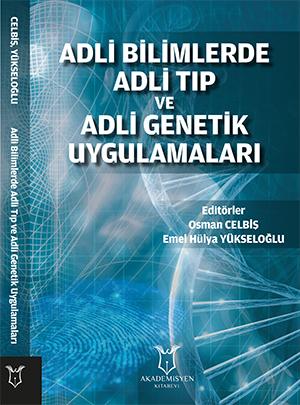
Yeni Nesil Adli Genetik Analizler, Fenotipleme ve Biyocoğrafik Soy Markırları
Özet
Bu çalışma, yeni nesil dizileme (NGS) teknolojilerinin adli genetik alanındaki gelişimi, uygulamaları ve kapiler elektroforez gibi geleneksel yöntemlere sunduğu üstünlükleri ele almaktadır. NGS platformları, Sanger dizileme ve kapiler elektroforez yöntemlerinin sınırlı boya ve çözünürlük kapasitelerini aşarak yüzlerce örneği ve markırı aynı anda, hızlı ve güvenilir bir şekilde analiz etme imkânı sağlamaktadır. Adli genetikte karşılaşılan degrede DNA örneklerinde yüksek başarı gösteren NGS, kısa tekrarlayan dizilerin (STR) sadece uzunluk polimorfizmini değil, dizi varyasyonlarını da (izoaleller) ortaya çıkararak ayrım gücünü ve karışık örneklerin analiz başarısını artırmaktadır. Otozomal ve gonozomal STR’lerin yanı sıra tek nükleotit polimorfizmlerinin (SNP) aynı panelde incelenmesi; kimliklendirmenin ötesinde kişilerin göz, saç ve ten rengi gibi fiziksel özelliklerinin (fenotipleme) ve biyocoğrafik soy kökenlerinin tahmin edilmesine olanak tanımaktadır. Ayrıca mitokondriyal DNA'nın tamamının dizilenmesi ve mikrohaplotipler gibi yeni nesil markırların kullanımı; karmaşık akrabalık analizleri ve mutasyon vakalarının çözümüne önemli katkılar sunmaktadır. Yüksek maliyet, veri analizi zorluğu ve bazı platformlardaki kısa okuma uzunlukları gibi kısıtlamalarına karşın NGS, yüksek veri kapasitesiyle adli genetik alanında altın standart kabul edilen konvansiyonel sistemlerin yerini alma potansiyeline sahiptir.
Referanslar
Børsting C, Fordyce SL, Olofsson J, Mogensen HS, Morling N. Evaluation of the Ion Torrent HID SNP 169-plex: A SNP typing assay developed for human identification by second generation sequencing. Forensic Sci Int Genet. 2014;12:144-54.
Børsting C, Morling N. Next generation sequencing and its applications in forensic genetics. Forensic Sci Int Genet. 2015;18:78-89.
Brookes AJ. The essence of SNPs. Gene 1999; 234(2):177-86.
Bruijns B, Tiggelaar R, Gardeniers H. Massively parallel sequencing techniques for forensics: A review. Electrophoresis. 2018;39(21): 2642-54.
Buadu S. Forensic DNA genotyping by means of next generation sequencing: Analysis of Autosomal STRs of a Norwegian population sample using the ForenSeq FGx system. Master Thesis, The Arctic University of Norway, 2018.
Butler JM, Coble MD, Vallone PM. STRs vs. SNPs: thoughts on the future of forensic DNA testing. Forensic Sci Med Pathol. 2007 ;3(3): 200-05.
Butler JM,. Advanced topics in forensic DNA typing: Interpretation. 1. Baskı. San Diego: Academic Press, 2015.
De Knijff P. From next generation sequencing to now generation sequencing in forensics. Forensic Sci Int Genet. 2019; 38:175-80.
Eduardoff M, Santos C, de la Puente M, Gross TE, Fondevila M, Strobl C ve ark. Inter-laboratory evaluation of SNP-based forensic identification by massively parallel sequencing using the Ion PGM. Forensic Sci Int Genet. 2015;17:110-121.
Guo F, Yu J, Zhang L, Li J. Massively parallel sequencing of forensic STRs and SNPs using the Illumina® ForenSeq™ DNA Signature Prep Kit on the MiSeq FGx™ Forensic Genomics System. Forensic Sci Int Genet. 2017;31:135-148.
Forensic Ancestry and Phenotype SNP Analysis and Integration with Established Forensic Markers by Katherine Butler Gettings.
Gelardi C, Rockenbauer E, Dalsgaard S, Børsting C, Morling N. Second generation sequencing of three STRs D3S1358, D12S391 and D21S11 in Danes and a new nomenclature for sequenced STR alleles. Forensic Sci Int Genet 2014; 12:38–41.
Gettings KB. Forensic Ancestry and Phenotype SNP Analysis and Integration with Established Forensic Markers. PhD thesis, George Washington University, 2013.
Gettings KB, Aponte RA, Vallone PM, Butler JM. STR allele sequence variation: Current knowledge and future issues. Forensic Sci Int Genet. 2015;18:118-30.
Gettings KB, Kiesler KM, Faith SA, Montano E, Baker CH, Young BA ve ark. Sequence variation of 22 autosomal STR loci detected by next generation sequencing. Forensic Sci Int Genet. 2016;21:15-21.
Gettings KB, Kiesler KM, Vallone PM. Performance of a next generation sequencing SNP assay on degraded DNA. Forensic Sci Int Genet. 2015;19:1-9.
Goodwin S, McPherson JD, McCombie WR. Coming of age: ten years of next-generation sequencing technologies. Nat Rev Genet. 2016;17(6):333-51.
https://verogen.com/documentation/ Erişim Tarihi: Ağustos 2020.
Ion Torrent Manual https://assets.thermofisher.com/TFS-Assets/LSG/manuals/MAN0017972_031419_TorrentSuite_5_12_UG_.pdf Erişim Tarihi: Temmuz 2020.
Iozzi S, Carboni I, Contini I. Pescucci C, Frusconi S, Nutini AL. Forensic genetics in NGS era: New frontiers for massively parallel typing. Forensic Sci Int Genet. Supp. Ser. 2014;13:247-58.
Kidd KK, Pakstis AJ, Speed WC, Lagace R, Chang J, Wootton S ve ark. Microhaplotype loci are a powerful new type of forensic marker. Forensic Sci. Int. Genet. Suppl. Ser. 2013; 4: e123–e124.
Kulski JK. Next Generation Sequencing : Advances, applications and challenges. 1. Baskı. (Elektronik kitap): IntechOpen, 2016.
Liu J, Li W, Wang J, Chen D, Liu Z, Shi J, Cheng F ve ark. A new set of DIP‐SNP markers for detection of unbalanced and degraded DNA mixtures. Electrophoresis 2019; 40: 1795–1804.
Loman NJ, Misra RV, Dallman TJ, Constantinidou C, Gharbia SE, Wain J, Pallen MJ. Performance comparison of benchtop high-throughput sequencing platforms. Nat Biotechnol. 2012;30(5):434-9.
Mardis ER. Next-generation sequencing platforms. Annu Rev Anal Chem (Palo Alto Calif). 2013;6:287-303.
Mardis ER. DNA sequencing technologies: 2006-2016. Nat Protoc. 2017;12(2):213-18.
Meiklejohn KA, Robertson JM. Evaluation of the Precision ID Identity Panel for the Ion Torrent PGM sequencer. Forensic Sci Int Genet. 2017;31:48-56.
Metzker ML. Sequencing technologies - the next generation. Nat Rev Genet. 2010; 11(1):31-46.
Pakstis AJ, Speed WC, Fang R, Hyland FC, Furtado MR, Kidd JR ve ark. SNPs for a universal individual identification panel. Hum Genet 2010, 127:315.
Phillips C. Forensic genetic analysis of bio-geographical ancestry. Forensic science international Genetics 2015; 18: 49–65.
Rockenbauer E, Hansen S, Mikkelsen M, Børsting C, Morling N. Characterization of mutations and sequence variants in the D21S11 locus by next generation sequencing. Forensic Sci Int Genet. 2014;8(1):68-72.
Sachidanandam R, Weissman D, Schmidt SC, Kakol JM, Stein LD, Marth G ve ark. A map of human genome sequence variation containing 1.42 million single nucleotide polymorphisms. Nature. 2001; 409(6822):928-33.
Sanger F, Nicklen S, Coulson AR. DNA sequencing with chain-terminating inhibitors. Proc Natl Acad Sci. 1977;74(12):5463-7.
Seo SB, King JL, Warshauer DH, Davis CP, Ge J, Budowle B. Single nucleotide polymorphism typing with massively parallel sequencing for human identification. Int J Legal Med. 2013;127(6):1079-86.
Shendure J, Balasubramanian S, Church GM, Gilbert W, Rogers J, Schloss JA ve ark. DNA sequencing at 40: past, present and future. Nature 2017; 550(7676): 345-53.
Shendure J, Ji H. Next-generation DNA sequencing. Nat Biotechnol. 2008;26(10):1135-45.
Yang Y, Xie B, Yan J. Application of next-generation sequencing technology in forensic science. Genomics Proteomics Bioinformatics. 2014;12(5):190-7.