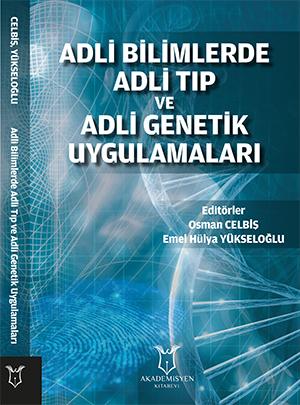
Adli Genetikte Nanoteknoloji Uygulamaları
Özet
Adli bilimler, işlenen suçların aydınlatılmasında insan müdahalesini ve hatasını en aza indirerek laboratuvar analizlerinin geçerliliğini ve güvenilirliğini en üst düzeye çıkarmayı hedefleyen multidisipliner bir alandır. Bu çerçevede nanoteknoloji, geleneksel tekniklerle tespit ve tanımlanması mümkün olmayan iz delillerin, biyolojik ajanların ve nano ölçekteki numunelerin hassas biçimde incelenmesine olanak tanır. Adli genetik alanında nanoteknolojik yöntemler; özellikle degrade olmuş, çürümüş veya antik iskelet kalıntılarından zararsız ve yüksek verimli DNA izolasyonu yapılmasını kolaylaştırırken, altın ve bakır gibi nanoparçacıkların kullanımı sayesinde PCR reaksiyonlarının duyarlılığını ve hızını kat kat artırmaktadır. Bunun yanı sıra Transmisyon Elektron Mikroskobu (TEM), Taramalı Elektron Mikroskobu (SEM-EDS), Atomik Kuvvet Mikroskobu (AFM), Raman Spektroskopisi, MALDI-TOF-MS, Yeni Nesil Dizileme (NGS) ve Lab-on-a-Chip (LOC) gibi gelişmiş cihazlar; olay yerinde 90 dakika gibi çok kısa sürede kontaminasyon riski olmadan otomatik DNA profillemesi yapılmasını mümkün kılmaktadır. Bu teknolojik olanaklar; gizli parmak izlerinin geliştirilmesi, sahtecilik, patlayıcı ve uyuşturucu maddelerin tayini, ölüm zamanı tahmini ve faili meçhul dosyaların çözümü hususunda kritik çözümler sunmaktadır. Ülkemizde bu alanda nitelikli uzman kadrolarının yetiştirilmesi ve yerli altyapının güçlendirilmesi, adli soruşturmalarda dışa bağımlılığı azaltarak adaletin doğru, tarafsız ve süratli işlemesine katkı sağlayacaktır.
Referanslar
Bandyopadhyay, A., Chatterjee, S., & Sarkar, K. (2011). Rapid isolation of genomic DNA from E. coli XL1 Blue strain approaching bare magnetic nanoparticles. Current science, 210-214.
Bhandare, N., & Narayana, A. (2014). Applications of nanotechnology in cancer: a literature review of imaging and treatment. J. Nucl. Med. Radiat. Ther, 5(4), 1-9.
Bhatt, P. V., Pandey, G., Tharmavaram, M., Rawtani, D., & Mustansar Hussain, C. (2020). Nanotechnology and Taggant Technology in Forensic Science. Technology in Forensic Science: Sampling, Analysis, Data and Regulations, 279-301.
Boom, R. C. J. A., Sol, C. J., Salimans, M. M., Jansen, C. L., Wertheim-van Dillen, P. M., & Van der Noordaa, J. P. M. E. (1990). Rapid and simple method for purification of nucleic acids. Journal of clinical microbiology, 28(3), 495-503.
Bruijns, B., Van Asten, A., Tiggelaar, R., & Gardeniers, H. (2016). Microfluidic devices for forensic DNA analysis: A review. Biosensors, 6(3), 41.
Bruijns, B. B., Tiggelaar, R. M., & Gardeniers, H. (2018). The extraction and recovery efficiency of pure DNA for different types of swabs. Journal of forensic sciences, 63(5), 1492-1499.
Carracedo, A. (Ed.). (2005). Forensic DNA typing protocols (Vol. 297). Springer Science & Business Media.
Chakraborty, D., Rajan, G., & Isaac, R. (2015). A splendid blend of nanotechnology and forensic Science. Journal of Nanotechnology in Engineering and Medicine, 6(1).
Chan, K. C., Muschik, G. M., Issaq, H. J., Garvey, K. J., & Generlette, P. L. (1996). High-speed screening of polymerase chain reaction products by capillary electrophoresis. Analytical biochemistry, 243(1), 133-139.
Chauhan, V., Singh, V., & Tiwari, A. (2017). Applications of nanotechnology in forensic investigation. International Journal of Life-Sciences Scientific Research, 3(3), 1047-1051.
Chen, Y. F. (2011). Forensic applications of nanotechnology. Journal of the Chinese Chemical Society, 58(6), 828-835.
Cheong, K. H., Yi, D. K., Lee, J. G., Park, J. M., Kim, M. J., Edel, J. B., & Ko, C. (2008). Gold nanoparticles for one step DNA extraction and real-time PCR of pathogens in a single chamber. Lab on a Chip, 8(5), 810-813.
de Souza, M. E., Lopes, L. Q. S., Vaucher, R. A., & Santos, R. C. V. (2014). Antibiofilm Applications of Nanotechnology. Fungal Genom Biol 4: e117. doi: 10.4172/2165-8056.1000 e117
Dilag, J., J Kobus, H., & V Ellis, A. (2011). Nanotechnology as a new tool for fingermark detection: a review. Current Nanoscience, 7(2), 153-159.
Endres, R. G., Cox, D. L., & Singh, R. R. (2004). Colloquium: The quest for high-conductance DNA. Reviews of Modern Physics, 76(1), 195.
Florczak, S., Kempka, K., Hołderna, K., Stanek, E., Baszyński, J., Kamiński, P., & Bogdzińska, M. (2017). DNA isolation method from human blood with MasterPure DNA Purification Kit™–review article. World Scientific News, 72, 69-76.
Ganesh, E. N. (2016). Application of nanotechnology in forensic science. environment, 1(1).
Gong, R., & Li, S. (2014). Extraction of human genomic DNA from whole blood using a magnetic microsphere method. International journal of nanomedicine, 9, 3781.
Grubu, N. S. (2007). Nanobilim ve Nanoteknoloji Stratejileri.
Hallikeri, V. R., Bai, M., & Kumar, A. V. (2012). Nanotechnology-The future armour of forensics: A short review. Journal of the Scientific Society, 39(1), 10.
Hartzell, B., McCord, B., Asare, D., Chen, H., Heremans, J. J., & Soghomonian, V. (2003). Comparative current–voltage characteristics of nicked and repaired λ-DNA. Applied physics letters, 82(26), 4800-4802.
Hasan, M. M., Hossain, T., Majumder, A. K., Momtaz, P., Sharmin, T., Sufian, A., & Akhteruzzaman, S. (2014). An efficient DNA extraction method from bone and tooth samples by complete demineralization followed by the use of silica-based columns. Dhaka University Journal of Biological Sciences, 23(2), 101-107.
Heng, J. B., Aksimentiev, A., Ho, C., Dimitrov, V., Sorsch, T. W., Miner, J. F., ... & Timp, G. (2005). Beyond the gene chip. Bell Labs Technical Journal, 10(3), 5-22.
Jakubowska, J., Maciejewska, A., & Pawłowski, R. (2012). Comparison of three methods of DNA extraction from human bones with different degrees of degradation. International journal of legal medicine, 126(1), 173-178.
Javan, G. T. (2015). Nanotechnology and Its Applications in Forensic and Criminal Cases. In Handbook of Research on Diverse Applications of Nanotechnology in Biomedicine, Chemistry, and Engineering (pp. 552-564). IGI Global.
Kesarwani, S., Parihar, K., Sankhla, M. S., & Kumar, R. Nano-Forensic: New Perspective and Extensive Applications in Solving Crimes.
Kouassi, G. K., & Irudayaraj, J. (2006). Magnetic and gold-coated magnetic nanoparticles as a DNA sensor. Analytical chemistry, 78(10), 3234-3241.
Kumar, N., Dorfman, A., & Hahm, J. I. (2006). Ultrasensitive DNA sequence detection using nanoscale ZnO sensor arrays. Nanotechnology, 17(12), 2875.
Labhasetwar, V., & Leslie-Pelecky, D. L. (Eds.). (2007). Biomedical applications of nanotechnology. John Wiley & Sons.
Lafi, A., Shehadi, I., Naggar, M. E., Alawadhi, H., Abdou, H. E., & Mohamed, A. A. (2017). Forensic Nanotechnology: Engineering Polyaniline Nanocomposites for Latent Fingerprints Development. Journal of Nanoscience and Nanotechnology, 17(5), 2865-2872.
Lindahl, T. (1993). Instability and decay of the primary structure of DNA. nature, 362(6422), 709-715.
Lodha, A. S., Pandya, A., & Shukla, R. K. (2016). Nanotechnology: an applied and robust approach for forensic investigation. Forensic Res Criminol Int J, 2(1), 00044.
Lu, C. H., Willner, B., & Willner, I. (2013). DNA nanotechnology: from sensing and DNA machines to drug-delivery systems. ACS nano, 7(10), 8320-8332.
Luftig, M. A., & Richey, S. (2000). DNA and forensic science. New Eng. L. Rev., 35, 609.
Magnani, M., Galluzzi, L., & Bruce, I. J. (2006). The use of magnetic nanoparticles in the development of new molecular detection systems. Journal of nanoscience and nanotechnology, 6(8), 2302-2311.
McCord, B. (2008). Nanotechnology and its Potential in Forensic DNA Analysis. Promega, septembre.
Min, J. H., Woo, M. K., Yoon, H. Y., Jang, J. W., Wu, J. H., Lim, C. S., & Kim, Y. K. (2014). Isolation of DNA using magnetic nanoparticles coated with dimercaptosuccinic acid. Analytical biochemistry, 447, 114-118.
Muntaha, R. A., Majid, H. A., Ayad, M. A., & Shaymaa, R. A. (2015). Intl Conf on J Medical Genetics. Cellular & Molecular Biology, Pharmaceutical & Food Sciences Istanbul.
Nazem, A., & Mansoori, G. A. (2014). Nanotechnology building blocks for intervention with Alzheimer’s disease pathology: implications in disease modifying strategies. J Bioanal Biomed, 6(2), 009-014.
Niha, A., Alok, P., Pinkesh, S., & Anand, L. Forensic Nanotechnology in Forensic Genetics. Peer Rev J Foren & Gen Sci 1 (1)-2018. PRJFGS. MS. ID, 107.
Nikalje, A. P. (2015). Nanotechnology and its applications in medicine. Med chem, 5(2), 081-089.
Pandya, A., & Shukla, R. K. (2018). New perspective of nanotechnology: role in preventive forensic. Egyptian Journal of Forensic Sciences, 8(1), 57.
Pitkethly, M. (2009). Nanotechnology and forensics. Materials Today, 12(6), 6.
Prasad, V., Lukose, S., & Prasad, L. (2016). Emerging forensic applications of nanotechnology. Int J Eng Allied Sci, 2, 1-8.
Rajeev, K., Suman, D., Jasbir, S., Ajay, K., & Raman, K. (2018). Role of nanotechnology in advancement, automation and miniaturization of DNA fingerprinting. Annals of Agri Bio Research, 23(1), 11-20.
Rakesh, M., Divya, T. N., Vishal, T., & Shalini, K. (2015). Applications of nanotechnology. Journal of Nanomedicine & Biotherapeutic Discovery, 5(1), 1.
Salata, O. V. (2004). Applications of nanoparticles in biology and medicine. Journal of nanobiotechnology, 2(1), 3.
Satvekar, R. K., Tiwale, B. M., & Pawar, S. H. (2014). Emerging trends in medical diagnosis: a thrust on nanotechnology. Med chem, 4, 407-416.
Sebastianelli, A., Sen, T., & Bruce, I. J. (2008). Extraction of DNA from soil using nanoparticles by magnetic bioseparation. Letters in applied microbiology, 46(4), 488-491.
Seeman, N. C. (2003). At the crossroads of chemistry, biology, and materials: structural DNA nanotechnology. Chemistry & Biology, 10(12), 1151-1159.
Shan, Z., Zhou, Z., Chen, H., Zhang, Z., Zhou, Y., Wen, A., ... & Servos, M. R. (2012). PCR-ready human DNA extraction from urine samples using magnetic nanoparticles. Journal of Chromatography B, 881, 63-68.
Shendure, J., Mitra, R. D., Varma, C., & Church, G. M. (2004). Advanced sequencing technologies: methods and goals. Nature Reviews Genetics, 5(5), 335-344.
Shewale, J. G., & Liu, R. H. (Eds.). (2013). Forensic DNA analysis: current practices and emerging technologies. CRC Press.
Shinde, S., Malve, M., Prabha, C., & Garad, M. (2010). Nanotechnology and forensic science. International Journal of Systems Biology, 2.
Singh, J., Sharma, N. R., Joseph, C. M., Khisse, D., Kaur, S., Rani, P., & Sahu, D. (2018). Nanotechnology And Its Applications In Forensic Sciences-A Boon To Legal Justice. Journal of Punjab Academy of Forensic Medicine & Toxicology, 18(1), 78-83.
Singh, R. K., Bansode, F. W., Sharma, S., Singh, P., Bhadauria, S., Singh, S., & Nath, C. (2015). Development of a Nanotechnology Based Biomedicine RISUG-M as a Female Contraceptive in India. Journal of Nanomedicine & Nanotechnology, 6(4), 1.
Singh, Y. (2014). Trends in biomedical nanotechnology. Journal of Nanomedicine & Biotherapeutic Discovery, 4(2), 1.
Srividya, B. (2016). Nanotechnology in Forensics and Its Application in Forensic Investigation. J Pharmace Nanotech, 4(2), 1-7.
Syduzzaman, M. D., Patwary, S. U., Farhana, K., & Ahmed, S. (2015). Smart textiles and nano-technology: a general overview. J. Text. Sci. Eng, 5, 1000181.
Tanaka, T., Sasaki, T., Amemiya, Y., Takeyama, H., Chow, S., & Matsunaga, T. (2006). Discrimination of DNA mismatches by direct force measurement for identification of tuna species. Analytica chimica acta, 561(1-2), 150-155.
Tian, H., Hühmer, A. F., & Landers, J. P. (2000). Evaluation of silica resins for direct and efficient extraction of DNA from complex biological matrices in a miniaturized format. Analytical biochemistry, 283(2), 175-191.
Tzvetkov, M. V., Becker, C., Kulle, B., Nürnberg, P., Brockmöller, J., & Wojnowski, L. (2005). Genome‐wide single‐nucleotide polymorphism arrays demonstrate high fidelity of multiple displacement‐based whole‐genome amplification. Electrophoresis, 26(3), 710-715.
Valle, F., Bianchi, M., Tortorella, S., Pierini, G., Biscarini, F., & D’Elia, M. (2012). Nanotechnology for forensic sciences: Analysis of PDMS replica of the case head of spent cartridges by optical microscopy, SEM and AFM for the ballistic identification of individual characteristic features of firearms. Forensic science international, 222(1-3), 288-297.
Wilner, O. I., Willner, B., & Willner, I. (2012). DNA nanotechnology. In Nano-Biotechnology for Biomedical and Diagnostic Research (pp. 97-114). Springer, Dordrecht.
Yadav, S. K. (2015). Nanotechnology: a spark to the use of plant origin bioactive compounds in therapeutics. Single Cell Biol, 4(1), 108-109.
Yi, L., Huang, Y., Wu, T., & Wu, J. (2013). A magnetic nanoparticles-based method for DNA extraction from the saliva of stroke patients. Neural Regeneration Research, 8(32), 3036.
Zhou, Z., Kadam, U. S., & Irudayaraj, J. (2013). One-stop genomic DNA extraction by salicylic acid-coated magnetic nanoparticles. Analytical biochemistry, 442(2), 249-252.