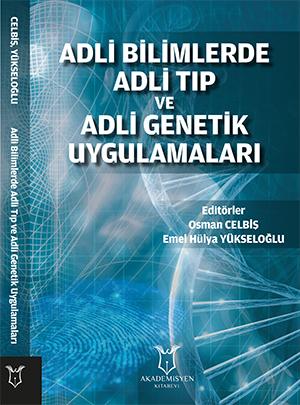
Adli Genetik Verilerin Değerlendirilmesinde Kullanılan İstatistiki Yöntemler
Synopsis
Forensic genetics demonstrates the uniqueness and evidentiary strength of DNA evidence before the court by calculating the matching probabilities of DNA profiles retrieved from crime scenes with suspects or other individuals. While polymorphic genetic marker systems such as STRs and SNPs are used in the typing of biological evidence, factors like contamination and degradation during analysis complicate the interpretation of results. Since it is impossible to access the DNA data of all individuals worldwide, population databases specific to certain ethnic or regional groups are established, and allele and genotype frequencies are statistically calculated based on the principles of Hardy-Weinberg Equilibrium. Furthermore, population genetics studies enable the determination of allele frequencies in society to establish exclusionary power, thereby assisting in identifying perpetrators and exonerating the innocent. Three main statistical approaches—the Frequentist approach (Random Match Probability - RMP), the Likelihood Ratio (LR) approach, and Bayes' Theorem—are utilized to evaluate the obtained DNA data. In parentage testing analyses, Paternity or Maternity Index (PI/MI) is calculated under the framework of Mendelian genetics laws and Bayes' Theorem, and the final posterior probability percentage is reported considering the 99.73% acceptance threshold in Turkey. For interpreting mixed DNA profiles, qualitative evaluation, match probability, combined probability of exclusion (CPE), and Likelihood Ratio (LR) methods are employed to ensure that complex biological evidence is presented to the judicial system in an understandable, reliable, and scientifically sound manner.
References
Alaeddini, R., Walsh, S. J., Abbas, A. (2010), Forensic implications of genetic analyses from degraded DNA—A review, Forensic Science International: Genetics, 4(3), 148–157. doi:10.1016/j.fsigen.2009.09.007
Amorim, A., Pinto, N. (2018), Big data in forensic genetic,. Forensic science international. Genetics, 37, 102–105. https://doi.org/10.1016/j.fsigen.2018.08.001
Budowle B., Eisenberg A.J., van Daal A. (2009), Validity of Low Copy Number Typing and Applications to Forensic Science, Croat Med J. 50, 207-17.doi: 10.3325/cmj.2009.50.207
Butler, J.M., Buel, E., Crivellente, F., McCord, B.R. (2004), Forensic DNA typing by capillary electrophoresis using the ABI Prism 310 and 3100 genetic analyzers for STR analysis. Electrophoresis. 25, 1397–1412. doi: 10.1002/elps.200305822.
Butler, J. M. (2010), Statistical Interpretation: Evaluating the Strength of Forensic DNA Evidence, J. M. Butler içinde, Fundamentals of Forensic DNA Typing (s. 229-258) Academic Press. ISBN 9780123749994, https://doi.org/10.1016/B978-0-12-374999-4.00011-4
Butler, J. M. (2015) Relationship Testing: Kinship Statistics, J. M. Butler içinde, Advanced Topics in Forensic DNA Typing: Interpretation (s.349-401) Academic Press ISBN 9780124052130, https://doi.org/10.1016/B978-0-12-405213-0.00014-2
Caliebe, A., Walsh, S., Liu, F., Kayser, M., Krawczak, M. (2017), Likelihood ratio and posterior odds in forensic genetics: Two sides of the same coin, Forensic science international. Genetics, 28, 203–210. https://doi.org/10.1016/j.fsigen.2017.03.004
Chakraborty, R. (1992), Sample size requirements for addressing the population genetic issues of forensic use of DNA typing, Human biology, 141-159.
Cole, S. A., Prainsack, B. (2015). Genetics and Forensics. International Encyclopedia of the Social & Behavioral Sciences, (s. 955–961). doi:10.1016/b978-0-08-097086-8.82050-4
Elkins, K. M. (2013), Computing Random Match Probability from DNA Profile Data Using Population Databases, K. M. Elkins içinde, Forensic DNA Biology, (s.115-120), Academic Press. ISBN 9780123945853, https://doi.org/10.1016/B978-0-12-394585-3.00013-4
Esen Melez, İ. (2013). Adli Genetiğe Giriş. İstanbul:Nobel Tıp Kitabevleri Tic. Ltd.Şti.
Evett, I.W., Weir, B.S. (1998), Interpreting DNA Evidence: Statistical Genetics for Forensic Scientists. MA: Sinauer Assoc., Sunderland.
Fung W. K., Hu Y. Q., (2008), Statistical DNA Forensics: Theory, Methods and Computation, John Wiley&Sons, England.
Gill, P., Bleka, Ø., Hansson, O., Benschop, C., Haned, H. (2020), Forensic genetics: the basics, Forensic Practitioner’s Guide to the Interpretation of Complex DNA Profiles,(s.1–53) Academic Press. doi:10.1016/b978-0-12-820562-4.00009-2
Gill, P.(2001), An assessment of the utility of single nucleotide polymorphisms (SNPs) for forensic purposes, International Journal of Legal Medicine, 114( 4-5), 204-210. doi:10.1007/s004149900117
Gjertson D. W., Brenner C. H., Baur M. P., Carracedo A., Guidet F., Luque J. A., Lessig R., Mayr W. R., Pascali V. L., Prinz M., Schneider P. M., Morling N., (2007), ISFG: Recommendations on biostatistics in paternity testing, Forensic Sci. Int: Genetics 1(3-4), 223-231 doi:10.1016/j.fsigen.2007.06.006
Godbey, W. T. (2014). An Introduction to Biotechnology: The Science, Technology and Medical Applications. Elsevier.
Houck, M. M., Siegel, J. A. (2016), DNA Analizi, Y. Doğan içinde, Adli Bilimlerin Temeli, İstanbul:Nobel Tıp Kitabevleri Tic. Ltd.Şti. (Orijinal eserin yayın tarihi 2010).
Kara, U., Yükseloğlu, E. H. (2015), Temel Adli Genetik, İstanbul:Nobel Tıp Kitabevleri Tic. Ltd.Şti.
Ladd, C., Lee, H. C., Yang, N., Bieber, F. R. (2001), Interpretation of complex forensic DNA mixtures. Croatian medical journal, 42(3), 244–246.
Linacre, A. M. T. (2018), DNA Profiling. Reference Module in Chemistry, Molecular Sciences and Chemical Engineering. doi:10.1016/b978-0-12-409547-2.14203-9
Oldoni, F., Podini, D. (2019), Forensic molecular biomarkers for mixture analysis. Forensic Science International: Genetics. doi:10.1016/j.fsigen.2019.04.003
Yükseloğlu, E. H., & Kara, U. (2018). Adli Uygulamalarda İstatistiksel Değerlendirme. Türkiye Klinikleri Adli Tıp-Özel Konular, 4(2), 29-36.
Zorlu T. (2015), Karışmış örneklerde STR analizinin LR (Likelihood ratio) kullanılarak yorumlanması, Doktora Tezi, İstanbul